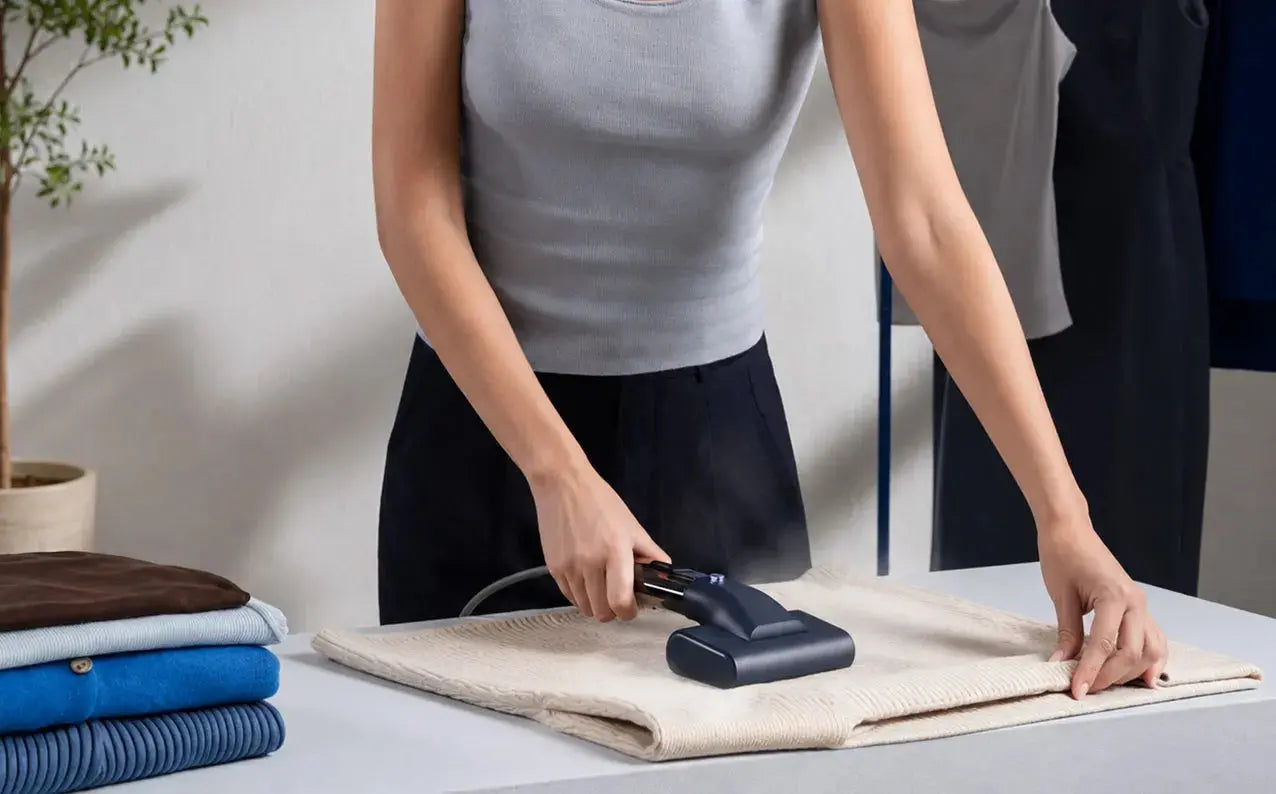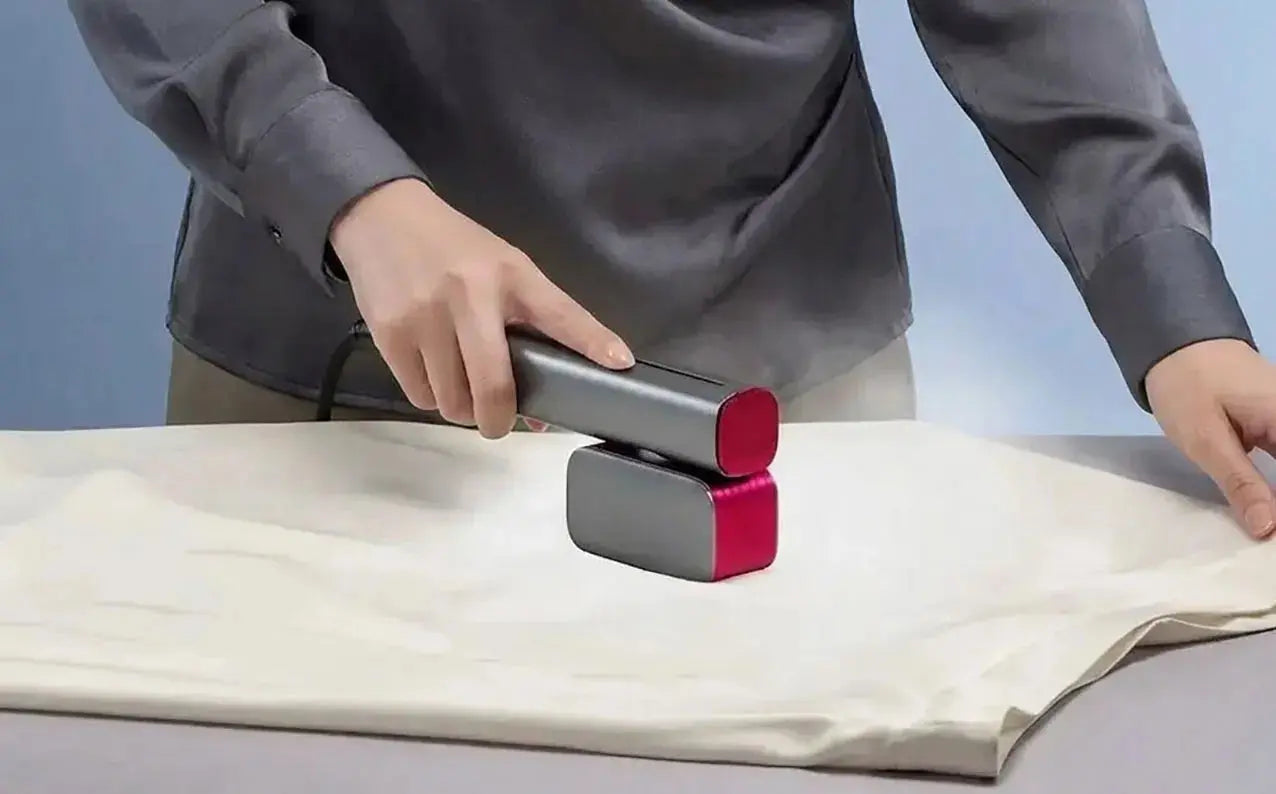

The least noticeable small appliance in my home is actually the one I use most frequently.
I used to think ironing clothes was particularly inhumane.
Especially when you're in a hurry in the morning.
You've just finished your makeup, halfway through curling your hair, when you suddenly realize the shirt you're supposed to wear today is wrinkled like it was dug out from under a suitcase. So you quickly grab an iron, hunt for an ironing board, plug it in, wait for it to heat up, and then carefully press the fabric while nervously wondering if you'll end up damaging the shirt.
By the end of the whole process, I was already annoyed.
Later I realized that many people aren't actually lazy about organizing their clothes—they just genuinely don't want to go through the whole process of traditional ironing.
It was from that time on that I gradually started using a steamer for clothes.
After using it, I realized this product isn't just for the refined few—it's actually perfectly suited to everyday life for ordinary people.

I first realized how useful the steamer was on a particularly awkward morning.
That day I was getting ready to go out and meet a friend.
I was wearing a linen dress.
When taken out of the closet, it was wrinkled in a highly layered way, as if someone had balled it up and stuffed it in.
I almost gave up right away.
Linen fabric can drive anyone crazy when ironing it.
Later, I remembered we had just bought a handheld steamer at home, so I quickly gave it a try.
I never expected the skirt to actually go smoothly in less than two minutes.
And it wasn't that stiff, flat look you get from an iron, but rather a very natural and relaxed state.
At that moment, I suddenly understood why more and more people are starting to stop using irons.
Because clothes treated with steam look more like what someone who knows how to live would wear.
An iron and a steamer are truly two entirely different concepts.
Many people will ask:
Can a garment steamer really replace an iron?
My answer is—most everyday situations, really can.
An iron is more like "forcibly flattening."
A steamer is more like "letting the fabric recover its natural shape."
Especially now, many people's clothing styles tend to be more casual:
Linen
Silk
Knitwear
Loose shirt
Cotton-linen set
These clothes actually don't need that sharp, "bank teller-level" crease effect.
Too flat, it would appear stiff.
The state after steam treatment will be more natural.
The feeling of just stepping out after changing clothes at a luxury hotel.
Not "I just carefully ironed for half an hour."

I later realized that the best thing to steam isn't actually a shirt.
but those clothes you're too lazy to deal with.
For example:
Linen
Linen is truly the kind of fabric that:
"You sit on it for five minutes, and it wrinkles right in front of you."
Yet people still love to wear them.
Because it's comfortable.
Because summer looks sophisticated.
I used to think linen was particularly difficult to care for.
Later I found that using a steamer was actually the most convenient.
Don't aim for a completely wrinkle-free look—just keep it smooth overall, and the texture will instantly come through.
Silk
Silk was the thing I used to dread ironing the most.
It's ineffective when the temperature is low.
Too high and it's easy to damage the fabric.
It became much easier after switching to steam.
Hang it up and steam gently; the fabric will gradually drape on its own.
And it won't suppress that softness.
Suit jacket
This is something I only discovered in recent years.
Many suits aren't actually "dirty," but rather "lifeless."
It will sag if hung for too long.
Especially the shoulders and hemline.
Steam it lightly, and the whole shape comes back to life.
You can restore many conditions without sending them to a dry cleaner.
The biggest mistake I made when buying a steamer was "buying based on specifications."
I used to always think:
The greater the power, the better.
Turns out, when I got it home, the machine was as heavy as a fitness equipment.
After filling the water, my hands were already sore from steaming two pieces of clothing.
Later I realized that whether a steamer is good or not depends not on its specifications.
But whether you are willing to take it out every day.
What truly affects the experience are actually just a few key points:
Is the steam output fast enough?
Does it leak?
Is it heavy?
Is it easy to store?
Can it be used conveniently on the go?
Especially, the "handy feel" is particularly important.
Because people are naturally prone to laziness.
If something requires complicated preparation, you'll usually give up after using it a few times.

I actually prefer the lightweight steamer now.
Especially the handheld model.
I used to think small machines definitely wouldn't be effective.
Later it turned out that many portable designs have already become quite mature.
When I first picked up something like Nesugar, which is on the lighter side, I was actually a bit surprised.
Because it's really light.
That feeling was particularly similar to:
Finally, someone is seriously considering how regular people feel about their wrists.
Especially when quickly getting dressed before leaving in the morning, being lightweight is truly essential.
It won't make you think:
"Never mind, I'm too lazy to bother."
Once you've experienced a water leak, you'll never forget it.
Many people don't pay much attention to this issue when buying a steamer.
But it really matters.
I used to have a garment steamer that suddenly started spraying water while steaming.
Water stains appeared all over my white shirt.
That day, I almost got late because I had to change clothes again.
Since then, I've been particularly concerned about leak-proof design.
A truly useful steamer should make life easier, not add new complications.

Travel steamer is actually very worth buying.
Especially if you travel frequently.
Hotel irons really depend on luck.
Sometimes they're fine.
Sometimes it's like opening a blind box.
The most terrifying thing is that—
You had just placed the white shirt on it when it suddenly sprayed out an unknown liquid.
You just stand there in silence.
Later, I started carrying a small steamer with me almost every time I went out.
Nowadays, many travel versions have become very convenient:
Compact size
Fast heating
Does not take up luggage space
Some models are dual-voltage compatible
Especially practical for long-distance travel.
Many clothes aren't actually unwearable—they're just wrinkled.
A quick steam immediately brings it back to life.
Later I realized that the steamer changed more than just clothes.
but the entire rhythm of life.
I used to often change my outfit on the spot because my clothes were wrinkled.
Nowadays, I hardly ever do.
Because I knew:
"Two minutes of steaming is enough."
Many clothes that were once tucked away in the closet have started being worn again.
including:
Linen pants
Silk shirt
Long dress
Suit
Coat
I even occasionally steam my curtains, bed sheets, and sofa cushions.
Not for the sake of being deliberately refined.
Rather, it's that feeling of "the house looks so cozy."
Very subtle.
But it really does affect your mood.
Looking back now, I'm most grateful that I didn't keep forcing myself to use the iron.
It's not that the iron is bad.
In some formal occasions, it is still necessary.
But for the daily lives of most ordinary people, a steamer is indeed much more convenient.
Its greatest advantage is not "how professional the effect is."
Rather, it lowers the barrier to organizing clothes.
You won't let so many clothes just lie in your closet anymore because you're too lazy to deal with them.
You won't be rushing around frantically every time you leave the house.
This small change may not seem significant.
But in the long run, life will truly become much easier.