
Plug Adapter vs. Voltage Converter: What's the Difference?
A plug adapter changes the shape of the connection. A voltage converter changes the electrical voltage.
That is the most important distinction to understand before traveling internationally with a clothes steamer.
If your steamer already supports a broad voltage range such as 100-240V, you generally do not need a separate voltage converter when the electrical supply at your destination falls within that range.
You may still need the correct plug or plug adapter because wall sockets differ between countries.
If your steamer is rated only for 120V and you are traveling somewhere with approximately 230V electricity, a basic plug adapter does not make the appliance voltage-compatible.
Electrical Safety First specifically notes that a travel adapter allows an appliance plug to connect to another socket type but does not convert voltage or frequency.
Source: Electrical Safety First ↗
The easiest rule to remember is:
Plug does not fit = adapter problem.
Voltage does not match = voltage problem.

The Short Answer
| Situation | Adapter Needed? | Converter Needed? |
|---|---|---|
| 100-240V steamer, plug fits destination | Usually no | No |
| 100-240V steamer, plug does not fit | Yes, correct plug adapter | No |
| 120V-only steamer in a 230V destination | Plug compatibility must be checked | Potentially yes |
| 230V-only steamer in a 120V destination | Plug compatibility must be checked | Potentially yes |
| Voltage rating unknown | Do not assume | Check appliance specifications first |
The first thing to check is therefore not the plug.
It is the voltage rating printed on your appliance.
What Does a Travel Plug Adapter Actually Do?
A travel plug adapter solves a physical connection problem.
Imagine you arrive at a hotel abroad with a US-style plug.
The wall outlet uses a completely different socket shape.
Your appliance may already support the local voltage, but the plug physically cannot connect to the outlet.
That is when a plug adapter is useful.
The adapter allows your existing plug to connect to the destination socket.
But it does not normally change the electricity being supplied.
If the wall outlet supplies 230V, the appliance still receives approximately 230V through a basic adapter.
Electrical Safety First explicitly states that travel adapters do not convert voltage or frequency.
Source: Electrical Safety First ↗
That is why the following combination can work:
100-240V appliance + correct destination plug adapter
while this can be a problem:
120V-only appliance + 230V outlet + simple plug adapter
The second setup solves the plug shape but not the electrical mismatch.

What Does a Voltage Converter Do?
A voltage converter addresses a different problem.
It changes electrical voltage from one level to another.
For example, suppose you have a clothes steamer designed only for approximately 120V, but your destination supplies approximately 230V.
The appliance and destination do not match electrically.
That is when a properly rated voltage converter or a different appliance may be required.
Electrical Safety First advises travelers that when the supply voltage differs from what the appliance supports, a converter or transformer may be necessary unless the appliance is dual-voltage rated.
Source: Electrical Safety First ↗
There is another important consideration with clothes steamers:
Wattage matters.
Garment steamers are heating appliances.
They generally consume far more power than small electronics such as phone chargers.
So if a converter is required, it must be appropriately rated for the appliance's electrical load.
This is one reason an international-voltage steamer can be simpler for frequent travelers than carrying a single-voltage appliance plus a high-power converter.
The First Thing to Check Is the Appliance Rating Label
Before buying any travel adapter or voltage converter, check the electrical label on your steamer.
You may see something like:
100-240V
This indicates that the appliance is designed to accept a broad range of electrical supplies.
120V
This indicates a much narrower voltage environment.
220-240V
This indicates that the appliance is designed primarily for higher-voltage electrical systems.
What matters is the actual voltage specification, not simply the marketing name.
A product can be called:
travel steamer
portable steamer
mini steamer
carry-on steamer
and still support only one electrical voltage.
The appliance label is what determines voltage compatibility.
What Does 100-240V Mean?
A 100-240V rating means the appliance is designed to operate across that stated voltage range.
This is especially useful for international travel because electrical supplies vary between destinations.
For example, travelers may encounter approximately 120V in the United States and approximately 230V in many European countries.
A 100-240V appliance covers both of those examples.
Electrical Safety First uses a rating such as 110-240V as an example of a dual-voltage appliance capable of working across that stated range.
Source: Electrical Safety First ↗
However, this does not mean that one physical plug will fit every wall socket in the world.
The two questions remain separate:
Can the appliance accept the voltage?
Can the plug connect to the socket?

Does a 100-240V Travel Steamer Need a Voltage Converter?
Normally, no, provided the destination voltage falls within the appliance's stated range.
For example:
Your steamer says:
100-240V
Your destination supplies:
230V
Because 230V falls inside the appliance's supported range, a separate voltage converter is generally unnecessary.
You then only need to determine whether your plug fits the destination socket.
This distinction is one of the biggest benefits of using a global-voltage travel appliance.
Instead of packing:
Steamer + voltage converter + plug adapter
you may only need:
100-240V steamer + appropriate destination plug
What About the NESUGAR G2 Pro?
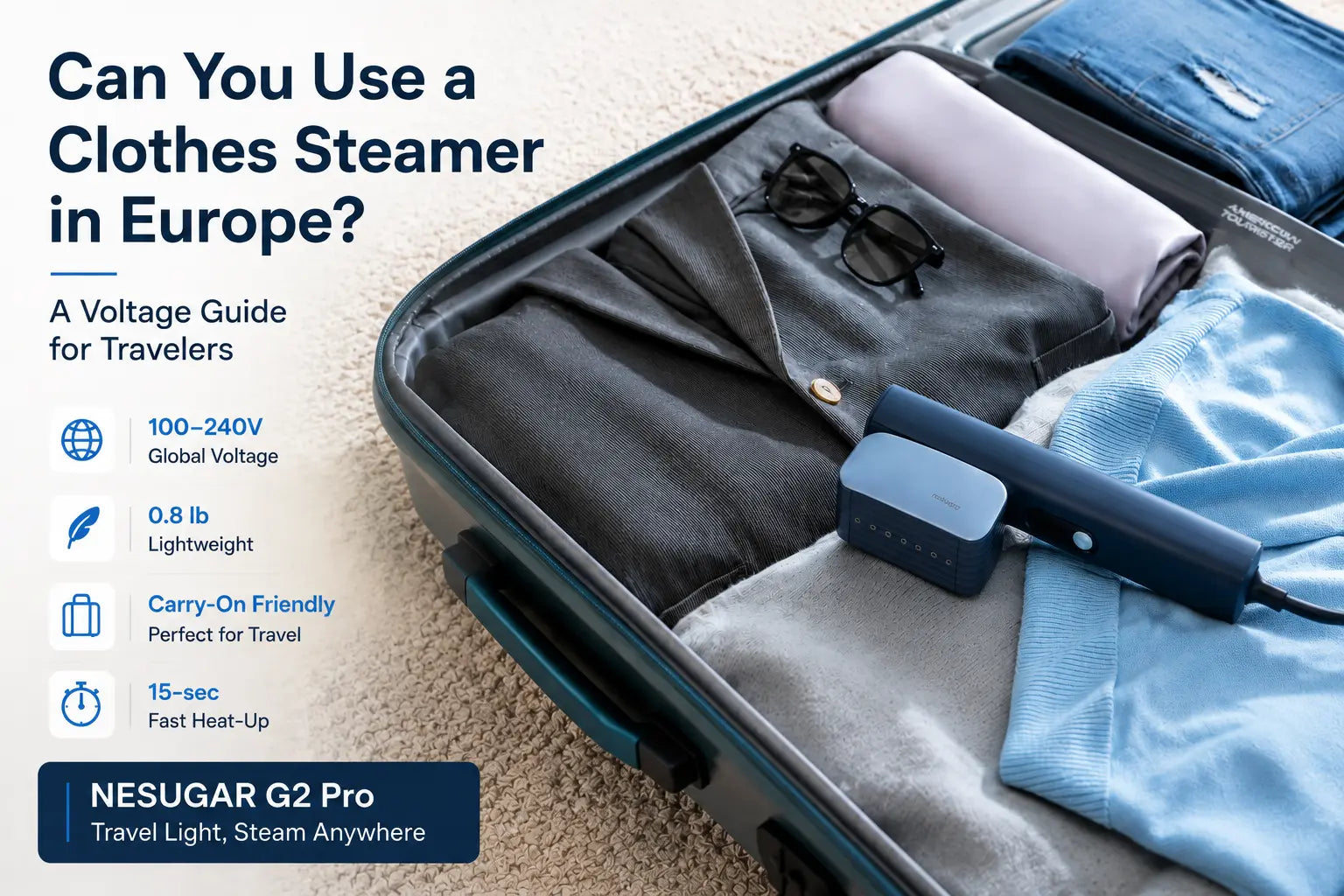
The NESUGAR G2 Pro Dual-Voltage Travel Steamer is currently rated for 100-240V.
The current NESUGAR product page lists the following specifications: Nesugar
| Specification | NESUGAR G2 Pro |
|---|---|
| Voltage | 100-240V |
| Power | 900W |
| Weight | 0.8 lb |
| Water Tank | 75 ml |
| Heat-Up Time | Approx. 15 seconds |
| Included Plugs | US Plug + EU Plug |
Product Data: NESUGAR G2 Pro ↗
The current product listing also states:
US Plug + EU Plug Included
and
No Voltage Converter Required. Nesugar
The important electrical specification behind that claim is the G2 Pro's 100-240V input range.
When the destination voltage falls inside that supported range, a separate voltage converter is not required for voltage compatibility.
However, travelers should still check the socket system used at their exact destination.
For example, the United Kingdom uses a different plug system from much of continental Europe. IEC maintains a country-by-country reference for global plug and socket systems.
Source: IEC World Plugs ↗

Does the NESUGAR G2 Pro Need a Voltage Converter in Europe?
Normally, no.
Many European destinations use approximately 230V electrical supplies.
Because 230V falls within the G2 Pro's stated 100-240V operating range, the appliance does not require a separate voltage converter purely for voltage compatibility. Nesugar
Product Data: NESUGAR G2 Pro ↗
Source: Electrical Safety First ↗
You should still verify the local socket type.
The G2 Pro currently includes a US plug and an EU plug, but Europe does not use one universal socket system.
Does the NESUGAR G2 Pro Need a Converter in the UK?
From a voltage perspective, normally no.
The United Kingdom uses approximately 230V / 50Hz, while the G2 Pro supports 100-240V.
The voltage therefore falls within the G2 Pro's supported range.
However, the United Kingdom uses Type G sockets.
Because the current G2 Pro package is listed with a US plug and an EU plug, travelers should check whether they need a suitable Type G adapter.
Source: Electrical Safety First - United Kingdom ↗
Product Data: NESUGAR G2 Pro ↗
In other words:
Voltage converter: normally no.
UK plug adapter: potentially yes.
Can a Universal Travel Adapter Replace a Voltage Converter?
Not necessarily.
The word "universal" can be misleading.
A universal travel adapter may support several different plug shapes, allowing one device to physically connect to outlets in several countries.
But that does not automatically mean it converts electrical voltage.
Always check the adapter's specifications.
If it is only a plug adapter, your appliance must still be compatible with the incoming voltage.
The safest order is:
Check appliance voltage first.
Check destination voltage second.
Check destination socket third.
Only then decide whether you need an adapter, converter or neither.
The U.S. State Department similarly advises international travelers to check both destination voltage and local electrical plug/outlet types.
Source: U.S. Department of State ↗

Why Clothes Steamers Need More Attention Than Phone Chargers
Many travelers are used to modern phone and laptop chargers that accept a broad international voltage range.
That can create the assumption that every portable appliance works the same way.
It does not.
Heating appliances should be checked individually.
The fact that a clothes steamer is compact enough for travel does not tell you what electrical system it supports.
Always check the rating label.
This principle also applies to travel irons, hair dryers, curling tools and other electrical heating appliances.
Why 100-240V Makes International Travel Simpler
A global-voltage appliance removes one major variable from international travel.
Instead of asking:
Will my appliance survive the local voltage?
at every destination, the appliance itself already supports a broad voltage range.
You still need to check plug compatibility, but the electrical planning becomes much simpler.
This is especially useful for frequent flyers, international business travelers, multi-country vacations and travelers moving between North America and Europe.
For G2 Pro users, the combination of 100-240V input + US and EU plug options is designed specifically around that travel use case. Nesugar
Product Data: NESUGAR G2 Pro ↗
Adapter or Converter? Use This Quick Rule
| If This Is the Problem | What You Need to Think About |
|---|---|
| Plug does not fit | Plug adapter |
| Destination voltage is outside appliance range | Voltage converter or different appliance |
| Appliance says 100-240V and destination is within range | Usually no converter |
| Voltage rating is unknown | Check the label or manual before use |
The safest travel habit is simple:
Never assume that because a plug fits, the appliance is electrically compatible.
Frequently Asked Questions
Do I Need an Adapter or Converter for a Travel Steamer?
It depends on both your steamer's voltage rating and the destination.
If the appliance already supports the destination voltage but the plug does not fit, you generally need a plug adapter.
If the destination voltage falls outside the appliance's supported range, a suitable voltage solution may be required.
Does a Plug Adapter Change Voltage?
No.
A basic travel adapter changes the physical connection between a plug and a wall socket. It does not normally change voltage or frequency.
Source: Electrical Safety First ↗
Does a 100-240V Steamer Need a Voltage Converter?
Normally no, provided the destination voltage falls within the appliance's stated 100-240V operating range.
You still need to check plug compatibility.
Can I Use a 120V Clothes Steamer in Europe With Only a Plug Adapter?
Not if the appliance supports only 120V and the destination supplies approximately 230V.
A plug adapter alone does not convert 230V electricity to 120V.
Source: Electrical Safety First ↗
Does the NESUGAR G2 Pro Need a Converter?
The G2 Pro is rated for 100-240V, so a separate voltage converter is generally unnecessary when the local electrical supply falls within that range. Nesugar
Product Data: NESUGAR G2 Pro ↗
Does the NESUGAR G2 Pro Come With a US and EU Plug?
Yes.
The current G2 Pro product listing states US Plug + EU Plug Included. Nesugar
Product Data: NESUGAR G2 Pro ↗
Can One Universal Travel Adapter Work Everywhere?
A universal adapter may support several plug types, but it does not necessarily convert voltage.
Check both the adapter specifications and the voltage rating of your appliance before use.
IEC maintains a country-by-country reference for plug and socket types around the world.
Source: IEC World Plugs ↗
Can I Use the NESUGAR G2 Pro in Europe?
From a voltage perspective, the G2 Pro's 100-240V range covers the approximately 230V electrical systems used in many European destinations.
The product currently includes an EU plug, but travelers should still verify the exact socket type used in their destination. Nesugar
Related Travel Steamer Guides: Can You Use a Clothes Steamer in Europe? A Voltage Guide for Travelers
Final Answer
A plug adapter changes the plug connection. A voltage converter changes voltage.
For international travel, start by checking the electrical rating printed on your clothes steamer.
If your appliance supports 100-240V and your destination's electrical supply falls within that range, you generally do not need a separate voltage converter.
You may only need the appropriate destination plug or adapter.
For the NESUGAR G2 Pro specifically, the current product specification lists 100-240V global voltage, 900W power, 0.8 lb weight, a 75 ml water tank, approximately 15-second heat-up, and both US and EU plugs included. Nesugar
The travel rule is simple:
Check voltage first. Check the socket second. Then decide whether you need an adapter or converter.