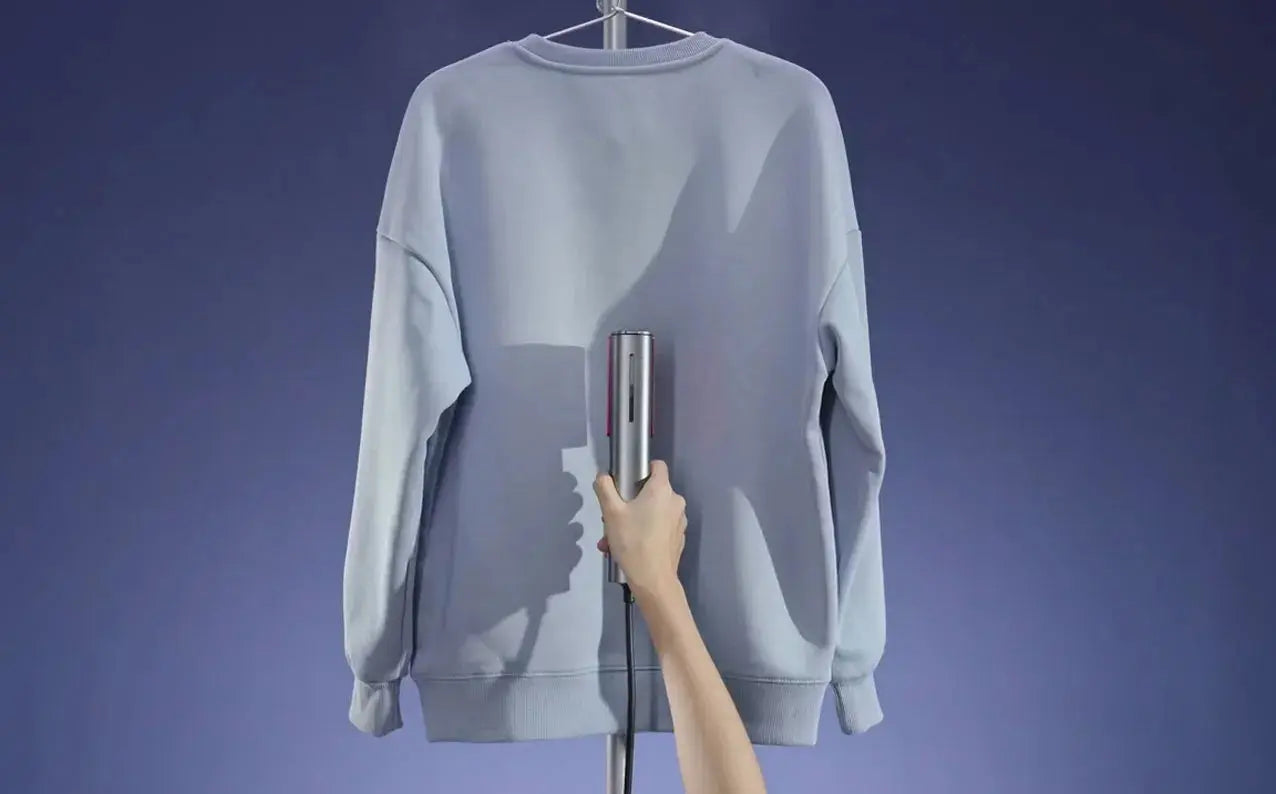

Over the years at the bank counter, I gradually learned one small thing: The wrinkles on clothes can really affect one's work mood for the entire day.
It's funny to say, but when I first joined the bank, the most nerve-racking part wasn't the speed of counting money or the system operation, but those few minutes every morning when I stood in front of the mirror.
Because our branch has very strict requirements for the image.
It's not something written down in the rules, but rather a tacit standard. What kind of shirt you wear, whether your pants are straight, and whether your cuffs are wrinkled - none of these details will be constantly reminded to you. But if you don't do them properly, you'll know it in your own mind.
I have been working at the bank counter for the seventh year now. Starting as a newbie fresh out of school, I have gradually grown to be able to handle complex business independently. And I have come to realize one thing:
The sense of professionalism comes half from ability and half from appearance and management.
What actually made it possible for me to achieve this with ease was actually a very small tool - the Portable Handheld Travel Steamer.
This article is my attempt to record the most genuine experiences of these years. It is not for promoting any products, but to clarify some small details that those working in the banking industry understand well.

Every morning at 7:40, my work has actually already begun.
Many people think that the work of a bank teller starts at 9 o'clock, but that's not true.
Our branch opens at 8:30, but I usually arrive there at 7:40.
The first thing to do when entering is not to sit down, but to change into work clothes.
We have a uniform: white shirts, trousers, dark shoes, and in winter, a suit jacket. Then, we put on our work badges, tidy up our hair, and do a little makeup.
Next comes the daily fixed routine:
- Count the cash in the tail box
- Check the accounts from the previous day
- Turn on the counting machine
- Log in to the system
- Attend the 5-minute morning meeting
After going through this set of procedures, it's approximately 8:20 now.
Then the customers began to enter the room one after another.
Sometimes it's retired people coming to collect their pensions, sometimes it's corporate finance staff handling corporate business, and sometimes it's young people seeking loan consultation.
Everyone is staring at you, waiting for you to speak.
At that moment, your state will directly affect the effectiveness of communication.
The first time I was reminded by my supervisor was because of a crumpled shirt.
I remember this event very clearly.
That day was Monday. The previous night, I worked overtime until very late. After washing the clothes, I went straight to bed. The next morning, I was in a hurry. I randomly picked a shirt from the closet and put it on without even looking at it carefully.
When we arrived at the branch, the staff was just about to open the counter. The supervisor came over and said in a very soft voice:
"This shirt looks a bit worn out today."
She didn't criticize me or say much more, but I immediately understood.
I rushed to the bathroom to look in the mirror, and then I realized that my shoulders and cuffs were all wrinkled, looking as if I hadn't slept at all.
That whole day I wasn't very comfortable. I always felt like the client was looking at my clothes.
Although maybe no one actually noticed, that feeling of insecurity would affect the rhythm of your speech.
From that point on, I began to take a small matter seriously:
The clothes should be clean and also neatly arranged.

The traditional iron, I persisted with it for three months but eventually gave up.
When I first became aware of this problem, my first reaction was to buy a better iron.
I even bought a folding ironing board and fixed a specific time each Sunday to iron all the shirts for the week. During that period, I felt very disciplined.
But reality soon defeated the plan.
There are several issues that are particularly obvious:
First, it takes too much time.
It takes about 10 minutes to iron a shirt from being laid out to being finished.
Five shirts a week would be nearly an hour.
Second, it is not flexible enough.
Sometimes on Wednesday night, you find out that you need to attend a meeting the next day, and you need to wear another shirt. You then have to iron it again on the spot.
Third, it takes up space.
The apartment I live in is a regular two-bedroom unit. The ironing board has always been placed in the corner of the balcony, and it just takes up a lot of space to look at.
After persisting for three months, I gradually became lazy.
What truly changed my habits was a training trip I went on.
Two years ago, I was assigned to go to another place for a four-day business training program.
That time I brought two suits and three shirts, and I folded them neatly and put them all into the suitcase. But when I opened it at the hotel, all the clothes were wrinkled.
The hotel does offer ironing services, but you have to call to request it and wait for the staff to bring it to you. I was already very tired that night and didn't want to go through the hassle.
When a colleague from the next room knocked on the door, I saw her holding a small device in her hand.
She said:
"I've been carrying this with me. It'll be done in three minutes."
That was the first time I saw the Portable Handheld Travel Steamer.
She hung the shirt on the closet door, turned on the machine, and steam began to emerge within less than a minute.
Starting from the neckline and moving downwards, in two or three minutes, the wrinkles were largely gone.
At that moment, I had only one thought in my mind:
It turns out to be so simple.

After returning to work, my mornings became much more relaxed.
Now my habits have become quite fixed.
After getting ready in the morning, I will hang the shirt I'm going to wear that day behind the door and quickly check it. If there is even a tiny crease, I will use steam to smooth it out.
The entire process took approximately two minutes.
How short is the time?
Sometimes I finish my work while listening to the morning news.
This matter may seem insignificant, but the changes it brings are quite obvious:
I no longer worry about the condition of my clothes.
I am more at ease when going out.
I am more confident at the counter.
Especially when customers are queuing for a long time, you have no time to regulate your emotions.
If your appearance is neat, your mind will be more stable.
Working at a bank counter, the details really get magnified.
Many people have never worked at a counter, and thus may not fully understand this feeling.
Our working environment is unique.
You have to deal with dozens or even hundreds of clients every day, and they are very close by.
Sometimes, the clients will stare at you through the glass window for several minutes.
They will notice:
Your expression
Your tone
Your attire
Even your cuffs.
Especially when handling large-scale transactions, customers tend to be more sensitive. If you don't appear to be professional enough, they will unconsciously ask more questions.
I once received an invitation from an enterprise owner. When he was processing a transfer, he suddenly asked me:
"Are you very busy today?"
I'm a little confused. I said I didn't have any.
He said:
"Seeing that your clothes are a bit wrinkled, I thought you had just finished your work shift."
At that moment, I truly realized:
The image represents not only yourself but also the entire organization.

Over the past few years, I have identified several particularly practical application scenarios.
To be honest, I use the Portable Handheld Travel Steamer much more frequently now than I originally imagined.
And it's not just about shirts.
The first scenario: Suddenly receiving a notice to attend a meeting
This kind of thing is very common in banks.
For instance, at 2 p.m., an unexpected notice was given:
"Meet at the conference room at 3 o'clock for the training session."
You might have been sitting for an entire morning, and your clothes are all wrinkled at the back.
If you just go straight there, it will look very casual.
At this point, simply treating it with steam will restore its original condition.
The second scenario: Organizing clothes during seasonal changes
Every spring and autumn, I will take out all the clothes from my closet and sort them.
Many clothes have been stored in the storage box for half a year, and they will inevitably have some odors and creases.
In the past, I could only wash them again. Now, I will first use steam treatment.
In particular:
Suits
Coats
Wool sweaters
Scarf
The effect is very obvious.
The third situation: Staying in a hotel during a business trip
I have now developed this habit.
As long as my business trip lasts more than two days, I will definitely take it with me.
Because I know:
The iron in the hotel may not work well
It may not be clean
And it may not always be available for borrowing
Bring one for yourself. It makes you feel at ease.
When choosing the equipment, I actually didn't think too much about the brands.
Many friends have asked me:
How did you make your choice in the first place?
To be honest, I didn't make a very detailed comparison. I just looked at a few key points:
First, the volume should be small.
Second, the weight must not be too heavy.
Third, the steam output speed should be fast.
Fourth, the operation should be simple.
Later, I chose a model from Nesugar. It was recommended by my colleague.
She has been using it for quite a while and said it has good stability.
At first, I bought it just out of curiosity. But I ended up using it for over two years.
No leakage
There were no faults
And there was no problem with unstable steam
For me, that's enough.
A small discovery: Steam really can make people feel more secure.
This might sound a bit abstract, but I truly experienced it myself.
In the past, if I found my clothes were wrinkled in the morning, I would be very anxious.
Because I knew that I would have to endure this uncomfortable feeling throughout the entire day at work.
It's different now.
I know I have a quick solution.
This feeling is like having a low battery on your phone, but having a power bank in your bag.
You will feel very at ease inside.
Over the years working in the bank, I have come to believe one thing more and more firmly.
Not all the details will be seen,
but the important ones will eventually be noticed.
For example:
Is the ID badge properly placed?
Are the dress shoes clean?
Is the shirt neatly pressed?
These things won't determine whether you can complete the business, but they will affect whether others trust you.
And trust, in the banking industry, is the most important asset.
If you ask me, is this little tool worth buying?
I won't simply say "worth it".
Because everyone's lifestyle is different.
But I can tell you:
If you fall into any of the following categories, it is highly likely to be helpful to you.
People who need to wear formal clothes for work every day
People who frequently travel on business
People who want to have more time in the morning
People who dislike ironing clothes
Or like me, someone who works in an industry that places great emphasis on appearance.
As I write this, I suddenly remember the first year I started working here.
At that time, I always felt that a profession is something that can only be achieved through hard work and dedication.
Later, it was gradually discovered that:
Professionalism is not only reflected in how much business you can handle,
but also in how you treat every detail.
Every morning now, as I stand in front of the mirror and look at a clean, smooth shirt, I feel a very stable sense of calm.
That is neither vanity nor formalism.
It is rather a state of being ready to face the day's work.
For a bank teller, this is more important than anything else.