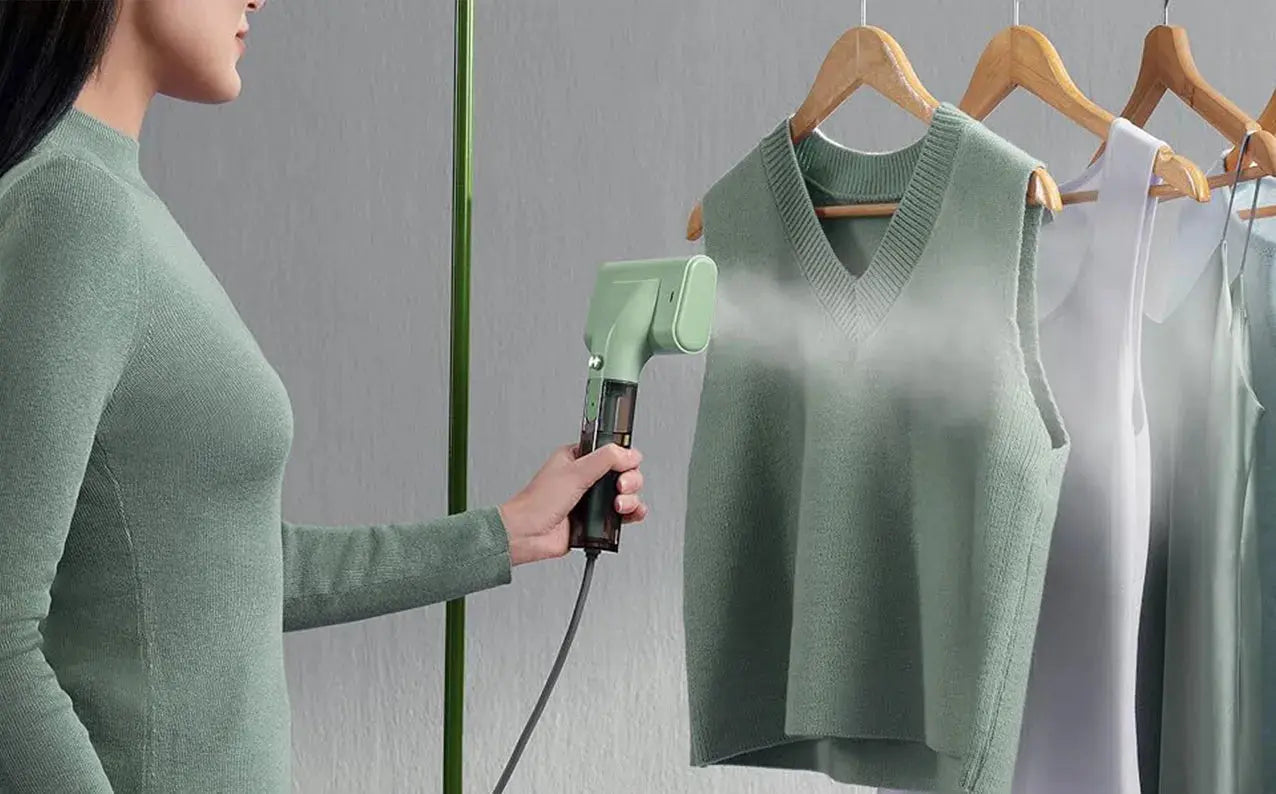

Why would I take a handheld clothes steamer seriously?
— Daily Observations of a Psychiatrist
If you ask me, after over a decade working in psychiatry, the most exhausting part has never been “patients,” but the constant concentration and emotional load.
Psychiatry is nothing like surgery. There are no clear incisions and no immediate visible results. What we deal with are people's emotions, defense mechanisms, traumatic memories, and long-established psychological patterns. After a day of outpatient work, I often feel my body is not tired, but my brain feels as if it has been occupied all day.
That's why I am extremely sensitive to any "unnecessary waste" in life.
Clothing, which seems to have nothing to do with psychiatry, turned out to be precisely the aspect that I later realized was the most overlooked.

In the consulting room, details are never trivial matters.
Every day, I have to deal with people from diverse backgrounds and in various emotional states:
There are patients who have just experienced major traumas, there are those who are chronically depressed but unaware of it, and there are also visitors who are highly vigilant about the world and always ready to defend themselves.
Before they sit down, they have already been observing me.
It's not a conscious process, but rather an instinctive scan —
Is this person stable? Is this person reliable? Are they trustworthy?
Whether one is dressed neatly or not can be interpreted by the brain within just a few seconds.
A wrinkled shirt, tired facial lines, all of these will be interpreted as "chaotic", "distracted" and "uncontrollable".
I once underestimated this point.
Until one day, a patient with an obsessive personality who was highly sensitive to order, repeatedly focused his attention on the creases in my clothes during the session. It wasn't being picky; rather, his anxiety found an outlet.
After that meeting, for the first time, I seriously reflected:
The external state of the doctor is itself a part of the therapeutic environment.
My patience for "complex household chores" is almost non-existent.
To be honest, I'm not particularly good at household chores.
The traditional iron has three major drawbacks for me:
- The process is complex.
- It takes up space
- Low fault tolerance rate
In the early morning of a busy workday, I simply can't spare half an hour to set up the ironing board, adjust the temperature, and do it over and over again. Doing so would only deplete the already limited energy I have before going out.
As a psychiatrist, I know one thing for sure:
People will not persist in doing something that makes them feel burdened for a long time.
This is why I eventually started using a handheld clothes steamer.

The logic of the handheld clothes steamer is quite "psychiatric"
The first time it really left a deep impression on me was at an interstate academic conference.
The hotel room was very small, and the suit was crushed beyond recognition in the suitcase. I didn't have high expectations to begin with, just hoping that it would be "a little better than nothing".
The result was that within a few minutes, the clothes regained their neat and tidy shape.
There is no noise, no complicated procedures, and no psychological burden of "I'm doing something very troublesome".
At that moment, I suddenly realized:
The steam is not “flattening” the clothes, but rather "relaxing" them.
This is extremely similar to what we do in the treatment.
Why is this method more likely to be used in the long term?
From a clinical perspective, the handheld clothes steamer is highly in line with human behavioral patterns:
1.Low entry threshold
No preparation is needed, no psychological preparation is required. Just pick it up and use it.
2.High certainty of return
The changes can be seen within minutes, and the brain will quickly establish positive feedback.
3.There is almost no cost of failure.
It won't damage the clothes and it won't be frustrated by any operational mistakes.
During the recovery period, I would advise many patients to establish "manageable small order". And organizing their clothes is actually a very safe and effective starting point.

Regarding Nesugar: A frequently used tool in the doctor's lounge
The first time I came across Nesugar, it wasn't because of an advertisement.
It was in the doctor's lounge of the hospital. The handheld clothes steamer was placed in the corner and could be taken by anyone who needed it. It was not discussed or emphasized particularly, but it was used almost every day.
In the medical environment, this "repeated use without being noticed" situation is itself a kind of screening result.
Later, I used it myself for a period of time. The experience was quite simple:
- Not overly concerned.
- Not complicated.
- There is no need for me to adapt to it.
For me, this is exactly how a professional tool should be.
Why do I think it is suitable for people in high-pressure occupations?
According to my observation, handheld clothes steamer is particularly suitable for the following groups of people:
- Doctors, therapists, counselors
- Lawyers, financial professionals
- People who frequently travel on business and have a lot of meetings
- People whose emotions are easily magnified by their environment
It cannot replace all the meticulous ironing needs, but it can solve 80% of the daily tidying problems, and it consumes almost no mental energy.
Why would a psychiatrist write these?
I seldom write about daily necessities.
The reason why I am willing to take the time to record this is that it truly improves my daily routine. It doesn't make life "more refined", but makes it more stable and more controllable.
In the field of psychiatry, we repeatedly observe a fact:
What truly leads to long-term improvement is not grand changes, but rather these seemingly insignificant actions that can be accomplished every day.
Sorting out a piece of clothing is one of them.
Final Note
If you are looking for a way that doesn't add any burden but can maintain the basic order, a handheld clothes steamer is something you should seriously consider.
It is not about striving for perfection, but rather about leaving oneself a sense of stability amid high pressure and uncertainty.
For a psychiatrist, this is already of great significance.