
Why I Care So Much About the Condition of a Single Garment
A true account by an art consultant on why a steamer for clothes matters
I am often misunderstood by my friends, who think that my job is "dressing neatly every day and drinking champagne at galleries".
On the contrary, the truth is exactly the opposite.
As an art advisor, my time is mostly spent in places that remain out of sight:
The temperature-controlled rooms in the storage area, the backrooms of auction houses, the dining tables in collectors' homes, the early morning flights across cities, and the suffocatingly chaotic scenes just before the exhibition opens.
In these situations, the choice of clothing is not a matter of style, but rather a matter of trust.

When Your Profession Is Judged at First Glance
Many people are unaware that the profession of art advisor is highly dependent on "non-verbal cues".
When I first enter the home of a new collector, before even starting to discuss the provenance, restoration history or market trends of the works, the other person has unconsciously made their first judgment:
Is this person reliable?
Does this feel professional enough?
Is it worth entrusting a seven-digit work to him for advice?
The smoothness of the clothes, the condition of the fabric, and the overall cleanliness will all contribute to this silent assessment.
Precisely because of this, my requirements for clothes have never been about "looking good", but rather about being stable, restrained, and free of mistakes.
I once suffered a bad experience because of a suit jacket.
That was in Chicago.
The night before, I had just landed. The next morning, I had to accompany the client to view a private collection. The suit had been squeezed all the way in the suitcase, so I thought I could just do a quick clean-up.
The old-fashioned iron in the hotel room had a blurry temperature control and its base was shiny. I still took a chance and ironed the front of my coat.
The result was exactly what you would expect.
The wool fibers had been pressed to reveal an unnatural "shine", which is very obvious under the light.
After that meeting ended, the client said nothing, but I became aware of one thing very clearly:
Some mistakes won't be pointed out, but they will be remembered.
I began to re-understand the matter of clothing care.
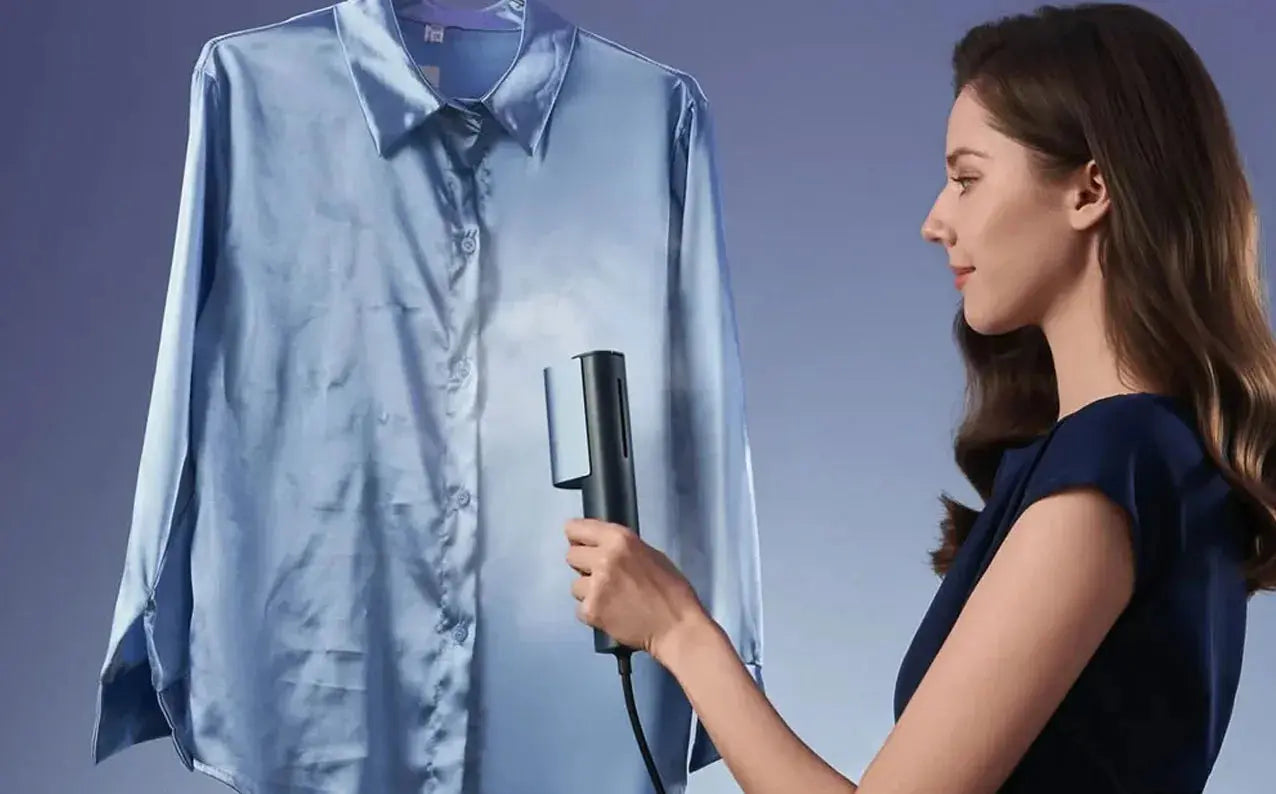
It was after that incident that I began to seriously study steamer for clothes.
At first, it was not for "convenience", but to reduce risks.
The way steam interacts with fibers is completely different from an iron. It doesn't flatten but relaxes; it doesn't force but guides. This is particularly important for those who frequently come into contact with high-end fabrics.
Especially for wool, fabric for suits, silk shirts, and even some custom-made garments with special weaving techniques —
they need to be "restored", rather than "corrected".
My working environment has determined that I must rely on steamer for clothes.
If your life consists of a fixed desk and a fixed wardrobe, you might not notice any difference.
But my daily routine is:
Stay at a hotel the day before the exhibition
Getting dressed at six in the morning
Already moving between different spaces before nine o'clock
Sometimes, within a single day, one has to meet three groups of clients with completely different backgrounds.
At this pace, I simply can't and shouldn't be dealing with the ironing board and the temperature control knob.
For me, a steamer for clothes is a tool for organizing my work process.

How Do I Decide Whether a Steamer for Clothes Is “Reliable”?
I never pay attention to exaggerated promotional points. Instead, I only focus on these practical issues:
Whether the steam is continuous and uniform
The unstable steam leaves "semi-treated" marks on the clothes, which is the part I can't stand the most.
Can I use a steamer for clothes without feeling tense?
A truly good tool won't make me constantly worry about the fabric getting damaged when I use it.
Is it suitable for frequent and long-term use?
I don't need "occasional surprises", what I need is for everything to go smoothly every single day.
Whether it respects the original state of the clothes
Clothes shouldn't look as if they have been "treated", but rather as if they have just "woken up from the closet".
The discovery of Nesugar was actually quite accidental.
The first time I heard about Nesugar, it wasn't on the internet.
Rather, it was during the backstage of an art exhibition when several colleagues were chatting about the items mentioned in their business trip preparations.
Later, when I myself came into contact with and used it, it was only because of the need for my profession to verify:
Whether a steamer for clothes can truly understand the actual usage situation, rather than the idealized demonstration scenario.
I have always believed that brands don't need to be mythologized.
The ability to remain stable and not disturb users over a long period of time is in itself a kind of capability.

Why I No Longer Pay Attention to “Parameters”
Many people have asked me what parameters to look for when choosing a steamer for clothes.
To be honest, I haven't looked at those numbers for a long time.
What truly affects the experience is how you feel when you are in a rush in the morning, how at ease you are when checking your clothes in the light, and that sense of certainty you have before going out without having to repeatedly look in the mirror.
These items are not listed in the parameter table.
The steamer for clothes brought about a change in my working state.
When clothes no longer become a variable, you will discover:
Morning brings more composure.
More focused attention.
Communicating with customers becomes more natural.
This is of great practical significance for a profession that regards "trust" as its core asset.
Final Note
I always believe that good tools shouldn't be over-discussed.
The meaning of their existence is to make you forget about their existence.
If you are considering whether you need a steamer for clothes, you might start by asking yourself this question:
Does your life allow clothes to be an uncertain factor?
For me, the answer has been quite clear all along.
—
An art advisor who has long lived between art and reality, and is used to managing risk at the smallest details.