
Can a Handheld Steamer Really Remove Wrinkles? Here’s What Actually Works
I used to think getting wrinkles out of clothes meant dragging out the ironing board, plugging in the iron, and spending ten minutes asking myself one very important question:
Why do I own so many clothes?
Then I started using a handheld steamer.
But that got me wondering:
Can a handheld steamer actually remove wrinkles, or does it just heat up my clothes, make them slightly damp, and pretend it did its job?
The short answer? Yes, it can.
But how well it works depends on three things: the fabric, how stubborn the wrinkles are, and—most importantly—how you use the steamer.
Honestly, your technique can matter just as much as the steamer itself.

How Does a Handheld Steamer Remove Wrinkles?
A handheld steamer works differently from a regular iron.
An iron relies on a hot soleplate that makes direct contact with the fabric. The heat and pressure help flatten the fabric.
A handheld steamer, on the other hand, uses steam to relax the fibers in the fabric and smooth out wrinkles.
That's one of the things I like most about using a steamer.
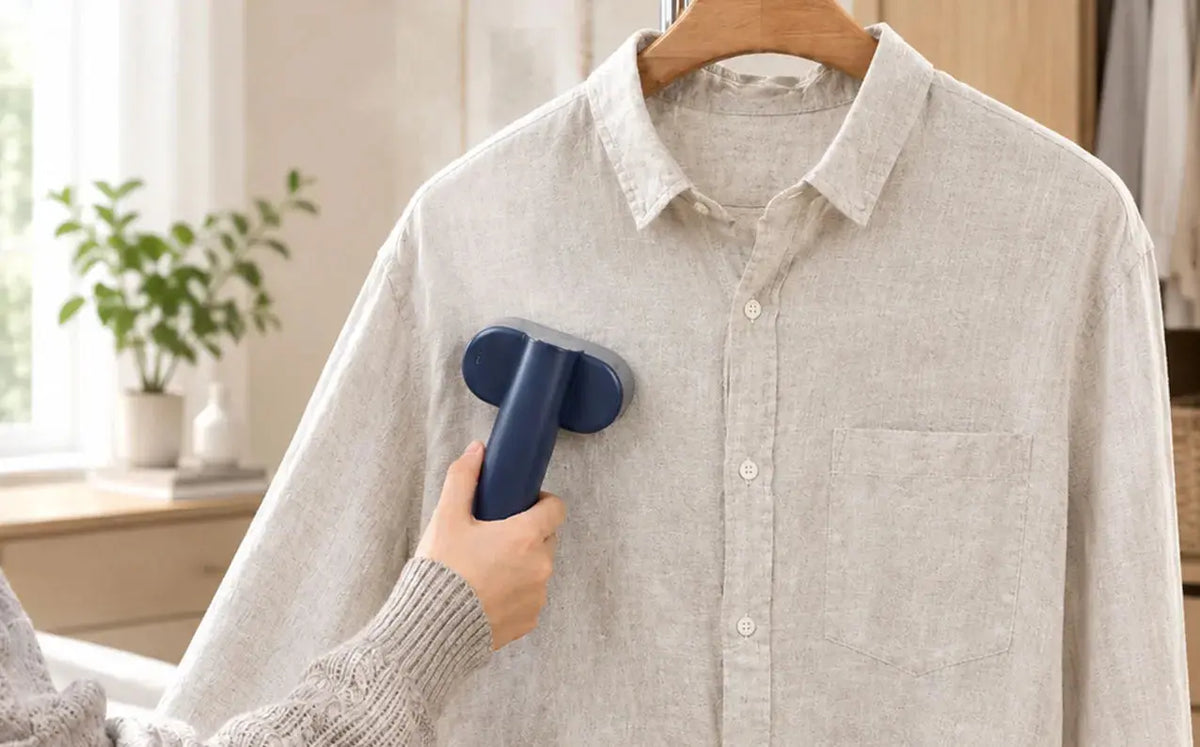
You can simply hang the garment up and get to work.
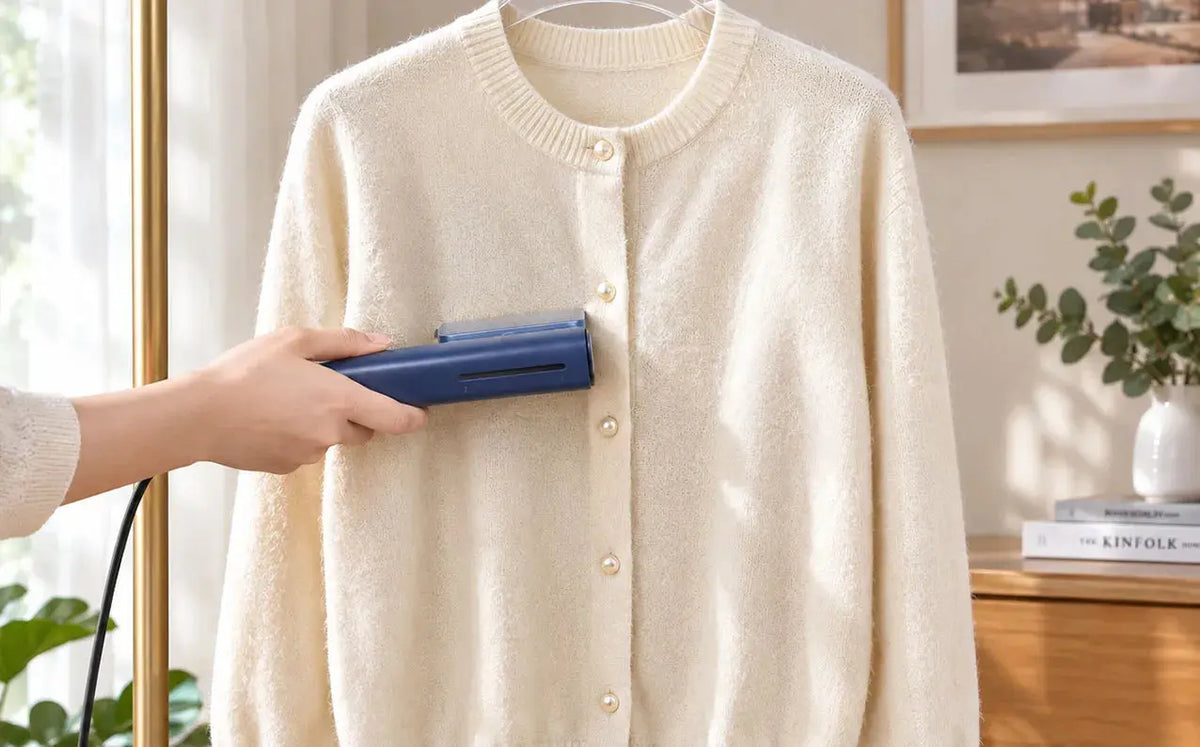
I usually hang the clothes first, then slowly move the steamer from top to bottom. As the steam works its way through the fabric, the wrinkles gradually start to loosen and disappear.
No ironing board. No finding a place to lay everything flat.
Just hang the clothes up and start steaming.
Much easier.
Can a Handheld Steamer Remove Deep Wrinkles?
Yes—but don't expect it to perform miracles every single time.
For light to moderate wrinkles, a handheld steamer is usually extremely effective.
Think of clothes that have been sitting in your closet for a while, something fresh out of the dryer, or clothes that got wrinkled after being stuffed into a suitcase.
Those are usually pretty easy to handle.
But if a shirt has been crushed inside a suitcase for three days with half your luggage sitting on top of it, I'm not expecting to wave the steamer over it twice and suddenly have a perfectly pressed shirt.
In that situation, I gently pull the fabric taut and spend a little more time on the worst areas, making a few extra passes if necessary.
This is especially helpful with fabrics like cotton and linen that tend to develop more noticeable creases.
When it comes to stubborn wrinkles, slowing down is often more effective than simply blasting the fabric with more steam.

Which Fabrics Work Best With a Handheld Steamer?
Different fabrics definitely respond differently to steaming.
Cotton
Cotton is generally a great fabric to steam.
T-shirts, button-down shirts, dresses, and other everyday cotton clothes usually respond well to steam when you're dealing with normal wrinkles.
If the fabric is particularly thick, I slow down and make a few extra passes.
Linen
Linen is a different story.
It can apparently develop wrinkles simply by existing.
I like using steam on linen because it helps the fabric look neater without completely taking away the natural texture that makes linen look like linen.
That said, if you want perfectly crisp linen that looks like it just came off a store display, a regular iron will probably give you better results.
Polyester and Other Synthetic Fabrics
These fabrics are usually pretty easy to freshen up with steam.
Lightweight dresses, shirts, blouses, and other garments can often look noticeably better after a few passes with a steamer.
Silk and Delicate Fabrics
This is where I get a little more cautious.
Always check the care label first.
Different fabrics have different temperature tolerances. Just because one garment can be steamed doesn't mean every garment should be treated with the same heat or steam setting.
If I'm not sure, I start with a gentler setting and increase it only if necessary.
Why Isn't My Handheld Steamer Removing the Wrinkles?
This is worth talking about.
When a steamer doesn't seem to be getting the job done, the problem isn't necessarily the steamer itself.
A lot of the time, it's the way we're using it.
1. You're Moving Too Fast
I used to make this mistake all the time.
I'd wave the steamer over my clothes as quickly as possible, looking like I knew exactly what I was doing.
Then I'd look down.
The wrinkles were still there.
They weren't even impressed.
Steam needs a little time to work its way into the fabric.
So when you're dealing with noticeable wrinkles, don't just fly over them. Slow down enough to let the steam actually work on the fabric.
2. The Garment Isn't Hanging Properly
It's best to hang your clothes on a sturdy hanger and leave yourself enough room to move the steamer around the garment.
Then use your other hand to gently pull the garment downward so the fabric has a little tension.
This small step can make a surprisingly big difference.
One hand handles the steamer.
The other hand keeps the fabric smooth.
Together, they work much better.
3. You're Using the Wrong Steam Setting
If your steamer has multiple settings, don't automatically crank it up to the highest level every time.
Different fabrics can require different heat and steam settings.
More steam doesn't automatically mean better results.
The right temperature and an appropriate steam level for the fabric are much more important.
4. It's Not Really a Wrinkle Anymore—It's a Deep Crease
There's a difference.
Regular wrinkles are usually fairly easy to relax with steam.
But if a garment has been tightly folded in the same place for a long time and developed a deep crease, especially if the fabric is thick, you may need several passes.
And if you're trying to create a sharp, perfectly straight crease, a traditional iron will probably be the better tool.
Some creases aren't wrinkles anymore.
They've basically decided to move in and stay there.

How I Steam Wrinkles Out of a Dress Shirt
If I'm getting ready in the morning and don't have time to mess with an ironing board, this is what I do.
Step 1: Hang the shirt up.
I use a sturdy hanger and let the shirt hang naturally.
Step 2: Let the steamer fully heat up.
I don't rush in the second I see a little steam coming out.
Step 3: Work from top to bottom.
I start around the collar and shoulders, then slowly work my way down.
Step 4: Keep a little tension in the fabric.
I hold the steamer in one hand and gently pull the garment downward with the other.
Step 5: Focus on stubborn wrinkles.
I don't blast one spot endlessly, but I also don't rush over it.
I slow down and make a few extra passes.
Step 6: Let the shirt hang for a few minutes.
Freshly steamed clothes can still have a little moisture in them.
I usually give the shirt some time to dry before putting it on.
It sounds simple, but this is one of those things I had to learn the hard way.
Handheld Steamer vs. Traditional Iron: Which Is Better?
For me, this isn't really a question of which one wins.
The better question is:
What kind of result do you need?
If I want to quickly get rid of everyday wrinkles, I usually reach for a handheld steamer.
I especially like it for:
- Quickly removing everyday wrinkles
- Steaming clothes while they're hanging
- Touching up an outfit before heading out
- Removing wrinkles from clothes after traveling
- When I don't want to drag out an ironing board
- Freshening up lightweight or delicate garments
A regular iron is still better for:
- A very crisp, perfectly flat finish
- Shirt collars and cuffs
- Sharp pant creases
- Heavy or stubborn wrinkles
- Creating precise, defined creases
So I wouldn't say a handheld steamer completely replaces an iron.
They're really two different tools for two different jobs.
If I'm getting ready for a meeting and discover that my dress shirt looks like it just got into a fight with my suitcase, I'll grab the handheld steamer.
But if I'm preparing a very formal outfit and want everything looking perfectly crisp and pressed, I might still reach for the iron.
So, Can a Handheld Steamer Really Remove Wrinkles?
Yes—and for everyday clothing, it's surprisingly useful.
Whether you're dealing with clothes pulled out of a suitcase, a wrinkled button-down shirt, a dress, linen clothes, or an outfit that needs a quick touch-up before you head out, a handheld steamer can handle a lot of common wrinkles very well.
The real trick isn't just pointing steam at a wrinkled shirt and hoping for the best.
It's this:
Hang it up → choose the right setting → gently pull the fabric taut → move slowly → go over stubborn wrinkles a few more times.
Once I got the hang of it, I stopped thinking of steaming as just a backup for those days when I didn't have time to iron.
For a lot of everyday clothing, it's simply the easier way to get dressed without looking like I slept in my clothes.
Because at 7:30 in the morning, the last thing I want to do is figure out where the ironing board is supposed to go.