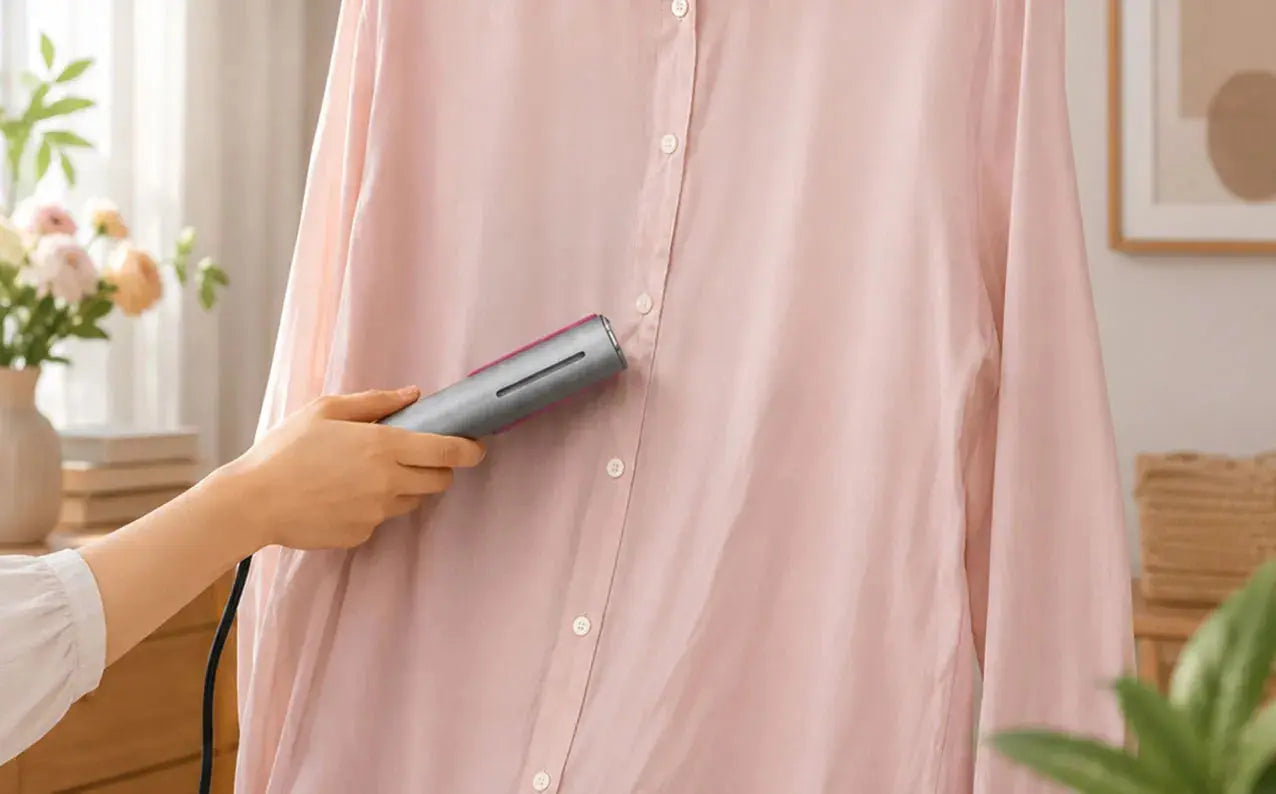

Yes, steam can damage some garments if it is used incorrectly or if the garment's care instructions specifically warn against steam. However, many everyday fabrics can be steamed safely when their care label permits it and the steamer is used correctly.
The most important rule is simple:
Check the garment care label before deciding whether to steam it.
Do not assume that a fabric is safe to steam simply because it is cotton, polyester, wool or silk.
Construction, dyes, coatings, decorative trims, blended fibers and finishes can all affect how a garment responds to heat and moisture.
The U.S. Federal Trade Commission's Care Labeling Rule specifically recognizes instructions such as “Steam only” and “No steam” / “Do not steam.” If steam could damage a garment, appropriate care instructions are supposed to communicate that limitation. Federal Trade Commission
Can Steam Actually Damage Clothes?
Steam itself is not automatically harmful to clothing.
The risk depends on several factors:
- the garment's care instructions
- fabric construction
- temperature
- moisture
- how long one area is exposed
- coatings or decorative elements
- whether the steamer produces dry, consistent steam or spits water
One practical problem is excessive moisture.
During Good Housekeeping Institute steamer testing, experts specifically look for spitting and sputtering, because overly wet steam can leave fabric wet and may create water spots. Their current testing covers linen, silk, cotton, wool and synthetic garments rather than assuming all fabrics behave the same way. Good Housekeeping
That means safe steaming is not simply:
Turn on steamer → point it at every garment.
It should be:
Check → Test → Steam gently → Inspect.

Always Check the Care Label Before Steaming
This is the most important section of this entire guide.
Care labels exist because two garments that look similar may require completely different treatment.
GINETEX, the international textile-care labeling organization, currently includes an ironing symbol specifically for:
low temperature without steam
and warns that steam can cause irreversible damage in some situations. GINETEX
The FTC similarly recognizes the wording:
No steam
or:
Do not steam
when steam should not be used. Federal Trade Commission
So if the garment label tells you not to use steam:
Do not override the garment manufacturer's care instructions simply because your steamer has a lower setting.
That principle is more important than any general fabric guide you find online.
Can You Steam Cotton?
Many cotton garments can tolerate steam, but the care label should still come first.
Cotton is commonly included in professional garment-steamer performance testing. Good Housekeeping, for example, evaluates steamers on cotton as well as cotton blends. Good Housekeeping
However, the word cotton does not tell you everything about the garment.
A cotton shirt may also contain:
- printed decoration
- interfacing
- adhesive elements
- synthetic trim
- embroidery
- blended fibers
Any of these could affect the correct care method.
A good approach:
1. Check the label
2. Start gently
3. Test an inconspicuous area if you're uncertain
4. Avoid holding concentrated steam over one spot for unnecessarily long periods
For a standard cotton business shirt that permits steam, a handheld steamer can be particularly convenient for relaxing suitcase wrinkles.
Can You Steam Linen?
Linen often responds well to steam when its care instructions permit it.
Wrinkles are particularly noticeable on linen, which is why linen is commonly used as a challenging test material when garment steamers are evaluated. Good Housekeeping includes linen in its current laboratory testing protocol. Good Housekeeping
But steaming and ironing produce different results.
Steam
Better when your goal is:
reduce wrinkles while preserving a softer, more relaxed linen look.
Iron
Better when your goal is:
create a flatter, sharper, more structured finish.
That distinction is also why our previous guide treats a steamer and iron as complementary garment-care tools rather than saying one completely replaces the other.
Related Guide:
Travel Steamer vs. Iron: Which Is Better for Travel?
Add the final published URL here once the first article is live.
Can You Steam Polyester?
Polyester requires a more careful answer than a simple yes or no.
Do not assume every synthetic garment can be treated exactly the same way.
GINETEX distinguishes between different ironing temperatures and specifically identifies low-temperature/no-steam treatment for some synthetic materials, while other care categories can permit steam. GINETEX
What matters is therefore the garment's actual care instruction.
A polyester garment might also contain:
- elastane
- nylon
- acetate
- printed graphics
- heat-sensitive trim
- adhesive construction
That can change the appropriate treatment.
Best practice
If the label permits steaming:
start gently and avoid unnecessarily prolonged exposure to one area.
If the label says:
Do not steam
don't steam it.
Can You Steam Silk?
Some silk garments can be steamed, but silk should not be treated as universally steam-safe.
Good Housekeeping includes delicate silk in professional garment-steamer testing, demonstrating that steamers are commonly evaluated for this type of fabric. Good Housekeeping
But individual silk garments can differ considerably.
The fabric may have:
- special dyes
- prints
- finishes
- lining
- embellishments
- unusual construction
For that reason, the care label matters more than the word silk.
Before steaming silk:
Check the label
↓
Test a hidden area
↓
Begin with gentle treatment
↓
Watch for moisture spotting or changes in appearance
If the garment is expensive, vintage, heavily embellished or particularly delicate, professional garment care may be preferable to experimenting.
Can You Steam Wool?
Wool often responds well to moisture and steam, but garment-specific care instructions still take priority.
Woolmark's wool-care guidance recommends steam when pressing many wool garments and explains that moisture can help with wrinkle removal and reshaping. At the same time, Woolmark explicitly tells consumers to read the sewn-in care label because treatment instructions vary between garments. Woolmark
External Source:
Woolmark — How to Care for Wool
This is particularly relevant for:
- wool trousers
- knitwear
- wool jackets
- lightweight wool clothing
But a tailored wool suit jacket can contain more than wool fabric.
Inside may be:
- lining
- padding
- interfacing
- adhesives
- structural materials
So the fact that the outer material says wool is not, by itself, enough information to determine every safe treatment method.
Can You Steam a Suit?
Light steaming can be useful for removing minor wrinkles from some suits when the garment's care instructions allow it.
This is particularly relevant after travel, when a jacket may have developed wrinkles from being folded or compressed inside luggage.
However, suits are structured garments.
A suit jacket may contain:
- canvas
- fused interfacing
- shoulder padding
- lining
- adhesives
- multiple fabric types
So you should not treat a tailored jacket like a simple cotton T-shirt.
For minor suitcase wrinkles:
Follow the suit's care instructions and use gentle treatment rather than prolonged concentrated steam.
If the jacket has serious creasing, structural distortion or difficult stains, professional garment care may be a better option.
What Materials Should You Be Careful About Steaming?
There are several situations where extra caution is appropriate.
Vinyl or Waxy Surfaces
Good Housekeeping specifically advises caution around materials such as vinyl and waxy finishes when discussing garment steaming. Good Housekeeping
Heat and moisture may interact poorly with special surface treatments.
Plastic Trim
Be careful around thin or heat-sensitive plastic decorations.
Examples include:
- plastic prints
- glued embellishments
- decorative patches
- synthetic logos
- heat-applied graphics
Good Housekeeping's expert guidance similarly warns about items containing plastic trim that could react poorly to heat. Good Housekeeping
Special Coatings
Water-resistant, laminated, coated or chemically finished fabrics may have care requirements different from the underlying fiber.
Again:
The care label beats the generic fabric name.
Anything Labeled “Do Not Steam”
This one is simple.
Do not steam it.
The FTC specifically recognizes “No steam” / “Do not steam” as care instructions when steam should not be used during garment care. Federal Trade Commission
Can a Clothes Steamer Leave Water Spots?
Yes, particularly if the appliance spits water rather than producing consistent steam.
Professional steamer testing specifically evaluates whether steamers sputter or spit because excessive moisture can wet fabrics and create water spots. Good Housekeeping
This is another reason you should:
- allow the appliance to reach operating temperature
- use it according to the manufacturer's instructions
- avoid overfilling the tank
- keep the steamer in its intended operating position
- stop if it begins releasing unusually large droplets
For delicate or dark garments where water marks may be particularly noticeable, testing a less visible area first is sensible.

How to Steam Clothes Without Damaging Them
A safe routine is usually simple.
Step 1: Read the Care Instructions
Look for:
- temperature limits
- ironing instructions
- steam restrictions
- professional-cleaning instructions
If the label explicitly prohibits steam, stop there.
Step 2: Inspect the Garment
Look for:
- plastic trim
- coatings
- embellishments
- glued decoration
- unusual finishes
These areas may need more caution than the main fabric.
Step 3: Test an Inconspicuous Area
If you are unsure how a garment will react, begin somewhere that is not easily visible.
For example:
- inside hem
- inner seam
- underside of a garment
Check for:
- discoloration
- water marks
- texture changes
- distortion
before continuing.
Step 4: Keep the Garment Hanging
Handheld garment steamers are generally intended to work on vertically hanging clothing.
Good Housekeeping's testing protocol likewise evaluates steamers vertically on hanging garments rather than laying garments flat. Good Housekeeping
This allows the fabric to relax naturally.
Step 5: Avoid Overworking One Area
More steam does not automatically mean better results.
Use controlled passes rather than holding concentrated steam over one small area unnecessarily.
If the wrinkle is persistent, give the garment a moment and reassess rather than continuously applying heat and moisture.
Step 6: Let the Garment Dry
A garment may retain some moisture immediately after steaming.
Allow it to hang briefly before:
- wearing it
- folding it
- putting it back into luggage
- returning it to a tightly packed wardrobe
This helps avoid creating new wrinkles while the fabric is still warm or damp.
Is Steaming Safer Than Ironing for Delicate Clothes?
Not universally.
A steamer has one practical advantage:
it normally removes wrinkles without pressing a hot soleplate directly against the garment.
That can make steaming convenient for certain:
- flowing garments
- dresses
- blouses
- softly structured clothing
But that does not mean steam is automatically safe for every delicate fabric.
GINETEX's current care system specifically includes situations where steam should not be used because it may cause irreversible damage. GINETEX
Therefore the correct rule isn't:
Delicate fabric = use steam.
It is:
Delicate fabric = check the care instructions first.
What About the NESUGAR G2 Pro?
The NESUGAR G2 Pro is a compact handheld garment steamer designed around quick garment touch-ups at home and while traveling.
Its current specifications include:
| Specification | NESUGAR G2 Pro |
|---|---|
| Weight | 0.8 lb |
| Water Tank | 75 ml |
| Power | 900W |
| Heat-Up Time | Approx. 15 seconds |
| Voltage | 100–240V |
| Use Cases | Home / Travel / Business Trip |
These specifications are currently listed on NESUGAR's official product page. Nesugar
Product Data:
NESUGAR G2 Pro Dual-Voltage Travel Steamer
But regardless of which steamer you use:
The garment's care label should always take priority over general appliance claims.
That's especially important with:
- expensive garments
- delicate materials
- special finishes
- mixed-material clothing
- decorative trim

Quick Fabric Steaming Guide
| Fabric / Material | General Guidance |
|---|---|
| Cotton | Often suitable when care label permits |
| Linen | Often responds well to steam |
| Polyester | Check garment instructions and blends |
| Silk | Use caution; check label and test first |
| Wool | Often responds well to steam; follow care label |
| Structured suit jackets | Use gentle treatment and check construction/care instructions |
| Vinyl / waxy finishes | Avoid or use significant caution |
| Plastic decorations | Avoid direct heat/steam |
| Special coatings | Follow manufacturer care instructions |
| “Do Not Steam” label | Do not steam |
This table is a starting point — not a replacement for the garment care label.
Frequently Asked Questions
Can a Clothes Steamer Ruin Clothes?
Yes, it is possible if steam is used on a garment that cannot tolerate it, if excessive heat or moisture is applied, or if the garment's instructions specifically prohibit steam.
Always check the care label first. The FTC explicitly recognizes “No steam” and “Do not steam” instructions. Federal Trade Commission
Can You Steam Every Type of Fabric?
No universal rule says every garment can be steamed.
Different fibers, finishes, blends, decorations and garment constructions require different care.
The label on the specific garment should determine how you treat it.
Can You Steam Silk?
Some silk garments can tolerate gentle steam, but you should never assume all silk is the same.
Check the garment label and test an inconspicuous area before treating the entire item.
Can You Steam Polyester?
Potentially, if the garment's care instructions allow it.
Synthetic garments can contain heat-sensitive materials or blends, so always check the actual garment rather than relying only on the word “polyester.”
Can You Steam Wool?
Woolmark advises that steam can assist wrinkle removal when pressing many wool garments, while also emphasizing that the individual garment's care label should be followed. Woolmark
Can a Steamer Leave Water Marks on Clothes?
Yes.
Wet steam, spitting or sputtering can leave garments wet and may result in water spots, which is why this characteristic is specifically assessed in professional garment-steamer testing. Good Housekeeping
Can You Steam a Suit Jacket?
Some suit jackets can be lightly steamed when their care instructions permit it.
However, suits are complex garments containing multiple layers and materials, so gentle treatment and care-label guidance are particularly important.
What Does “Do Not Steam” Mean?
It means steam should not be used as part of the garment-care process.
The FTC's official terminology specifically defines “No steam” / “Do not steam” as an instruction not to use steam in pressing, finishing, steam cabinets or steam wands. Federal Trade Commission
Should You Test a Garment Before Steaming?
If you are uncertain how the garment will react, yes.
Test a hidden area and check for:
- color change
- texture change
- water spotting
- distortion
before continuing.
Final Answer
A clothes steamer can damage clothing, but problems are most likely when the garment is not suitable for steam or when the appliance is used incorrectly.
The safest approach is:
CHECK LABEL → TEST FIRST → STEAM GENTLY → LET DRY
Cotton, linen, wool, silk and synthetic fabrics can all appear in garments that are suitable for steaming, but the fiber name alone is not enough to determine safe treatment.
The garment's:
care label, construction, trims, finishes and manufacturer instructions
should always come first.
If a label says:
Do Not Steam
the answer is simple:
Don't steam it.