
Does a Fabric Steamer Really Remove Wrinkles? Here’s What Actually Works
There are two kinds of mornings.
The first: you wake up on time, your coffee tastes just right, and somehow your hair decides to cooperate. You open the closet, reach for the outfit you want to wear, and—miracle of miracles—it’s already wrinkle-free. For once, life feels like it has some kind of order.
The second kind?
You sleep through your alarm. Nearly spill coffee on yourself. Your hair looks like it got into a fight with your pillow.
Then you grab your favorite shirt.
Wrinkled.
Not just a little wrinkled.
The kind of wrinkled that makes you wonder:
“What exactly happened to this thing last night?”
That’s when I started taking my fabric steamer seriously.
If you’re searching for “does a fabric steamer remove wrinkles,” the short answer is:
Yes.
But after using one regularly, I realized the more interesting question isn’t whether a fabric steamer can remove wrinkles.
It’s which wrinkles it handles best—and why your clothes can still look like they just escaped from a suitcase even after you’ve been steaming them for several minutes.

How Does a Fabric Steamer Actually Remove Wrinkles?
The idea is pretty simple.
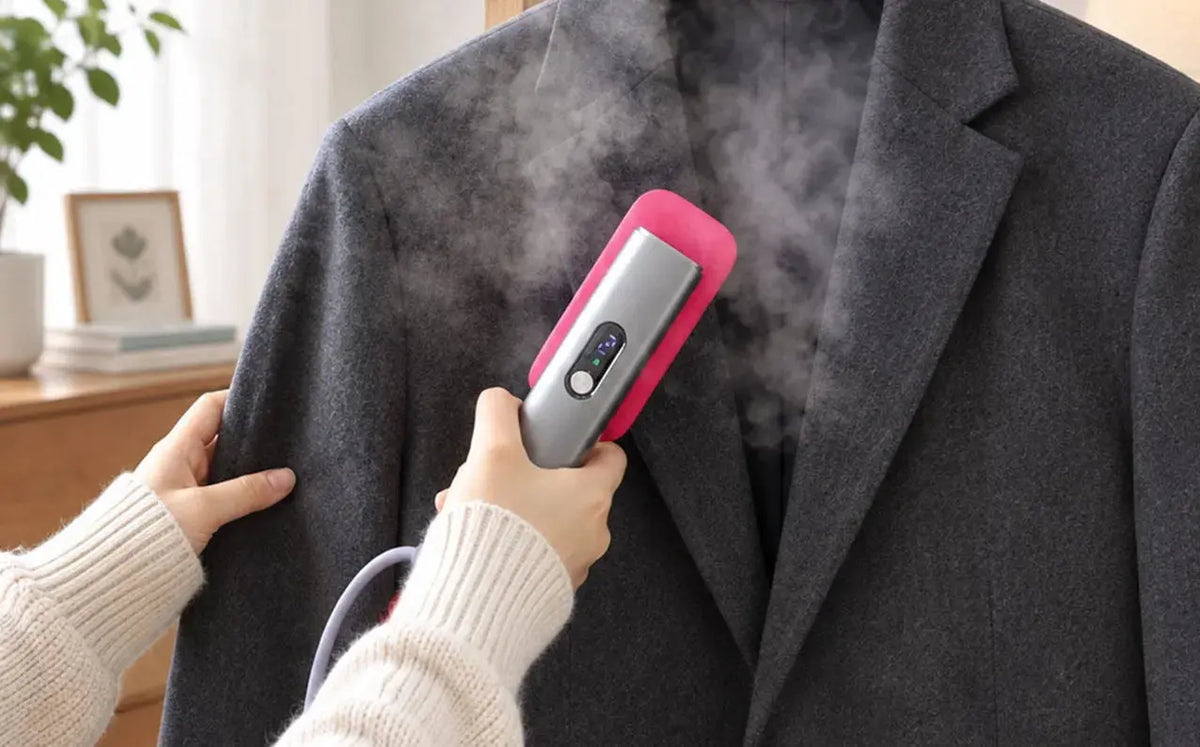
A fabric steamer heats water and turns it into steam. That warm moisture then comes into contact with the fabric.
When clothes are folded, compressed, or packed away for a while, the fibers can stay stuck in those bent positions. That’s what creates wrinkles.
Heat and moisture help relax the fibers.
As they loosen up and move back toward their natural shape, the fabric becomes smoother.
So I don’t really think of steam as something that forces wrinkles out.
It’s more like telling your shirt:
“Okay. You can relax now.”
And then letting the fabric do the rest.
That’s why steam works so well on the everyday wrinkles you actually deal with—creases from wearing, folding, hanging, or stuffing clothes into a suitcase.
But Not All Wrinkles Are Created Equal
This is something I seriously underestimated at first.
Some wrinkles are ridiculously easy to deal with.
Maybe your shirt has been squeezed between a bunch of other clothes in the closet. Maybe you put it on in the morning and notice a few wrinkles around the chest, sleeves, or hem.
Those are usually no big deal.
A few passes with a steamer can make a noticeable difference.
Then there’s another category:
Suitcase wrinkles.
If you travel, you know exactly what I mean.
Before you leave, you carefully fold your clothes and pack everything neatly.
Then you get to the hotel, unzip your suitcase, and discover that your clothes have completely lost their dignity.
There are creases across the shirt. Creases down the sleeves. Creases along the hem.
And somehow, the zipper has managed to leave its own little signature.
This is where a fabric steamer really earns its keep.
Then there’s the third category:
Deep-set creases.
Maybe a shirt has been sitting underneath a pile of clothes for months. Maybe it’s been folded along the same line over and over again.
Those wrinkles take more work.
Steam can soften and reduce them, but you may need to go over the same area more than once.
That’s normal.
The steamer isn’t suddenly refusing to cooperate.
The wrinkle has simply been living there for a while.

One Small Trick Made a Bigger Difference Than I Expected
If I had to pick one easily overlooked technique, it would be this:
Keep a little tension on the fabric.
A lot of people hang up their clothes, wave the steamer over the surface a few times, and call it a day.
Sure, the steam is reaching the fabric.
But the fabric is also swinging around the whole time.
That doesn’t exactly make the job easier.
Now I use a sturdy hanger and let the garment hang naturally. Then I use my free hand to gently pull the bottom of the garment downward.
Not hard.
And definitely not like I’m in a tug-of-war with my shirt.
Just enough to keep the fabric smooth and steady.
Then I work from top to bottom.
That tiny adjustment made a bigger difference for me than simply steaming the same area for longer.
Don’t Move Too Fast
This was another mistake I made when I first started using a steamer.
I’d move it quickly across the garment, feeling very productive.
In reality, I was barely giving the steam enough time to do its job.
Especially when you’re dealing with a noticeable crease, you can’t expect one quick pass to make it disappear.
Now, when I come across a deeper wrinkle, I slow down.
I give the steam enough time to work on the fabric before moving on.
Light wrinkles? Move a little faster.
Deeper creases? Slow down.
That’s really it.
Sometimes the most effective technique isn’t some advanced trick.
It’s simply:
Don’t rush.
What Clothes Are Best for a Fabric Steamer?
From my everyday experience, a fabric steamer is most useful for those “I need to wear this in five minutes, but it doesn’t exactly look ready” situations.
Things like:
- Dress shirts
- T-shirts
- Dresses
- Blouses
- Lightweight jackets
- Blended fabrics
- Many polyester garments
- Clothes pulled straight out of a suitcase
It’s especially handy for clothes that are better stored on hangers than folded.
But there’s one thing I always recommend:
Check the care label first.
Not every fabric should be treated the same way.
If you’re dealing with a delicate material, special finish, coating, embellishment, or anything you’re unsure about, test the steamer on an inconspicuous area first.
I’d rather spend ten extra seconds testing a garment than turn one of my favorite shirts into an unexpected science experiment.

Can a Fabric Steamer Remove Every Wrinkle?
No.
And honestly, I think being realistic about that is more useful.
A lot of product descriptions make household appliances sound like they have superpowers.
Real life is different.
A fabric steamer works really well on everyday wrinkles.
Light creases, wrinkles from wearing a garment, and many travel wrinkles are exactly the kind of problems steam is good at handling.
But if the fabric is particularly thick, or a crease has been pressed into the garment for a long time, it may take more effort.
You might need several passes.
Some fabrics also have a naturally textured appearance.
Even after steaming, they may not turn into perfectly smooth, flawless fabric.
And honestly?
That’s fine.
The goal is for your clothes to look neat and presentable.
We’re getting dressed to go out, not putting a freshly pressed shirt behind glass in a museum.
When I’m in a Hurry, This Is How I Steam My Clothes
This is the routine I use most often.
Once the garment is hanging, I don’t carefully steam every square inch from top to bottom.
I don’t have that kind of time.
Instead, I focus on the areas people are most likely to notice first.
The collar.
The shoulders.
The chest.
The sleeves.
Then I quickly work over the most visible areas on the front.
After that, I check the back and hem.
If I spot an obvious wrinkle, I go back and hit it again.
That’s usually enough.
I’m not trying to make every square inch of fabric look like it just came out of a luxury packaging box.
My goal is much simpler:
Make the clothes look clean, smooth, and presentable—and get out the door.
That feels a lot more realistic.
Especially at 7:30 in the morning.
Why I Like a Portable Steamer for Travel
Travel is basically the natural enemy of wrinkle-free clothing.
I’ve accepted that.
You carefully fold everything before leaving home. Then you arrive, open your suitcase, and somehow your clothes look completely different.
So when I need to freshen up clothes while traveling, I usually hang everything up first.
I don’t rush to put anything on.
Let the clothes hang for a bit.
Then I work through them section by section.
For shirts, I pay extra attention to the shoulders, chest, and sleeves.
For dresses, I work downward in sections.
Once I’m finished, I let the clothes hang for a little while longer.
I don’t immediately shove them back into a crowded closet.
Give the fabric a little time to cool down and settle.
It’s an easy step to overlook, but I’ve found it makes a difference.
A Few Things I Don’t Do Anymore
After using a fabric steamer for a while, I’ve developed a few personal rules.
If the care label says not to steam it, I don’t take the risk.
With delicate fabrics, I don’t aggressively press the steamer head against the garment.
With deep-set creases, I don’t give it two seconds and immediately declare the steamer useless.
And I don’t neglect the water tank or the steamer itself.
There’s one more rule that might be the most important:
I don’t treat every wrinkle like an emergency.
Some wrinkles disappear in two minutes.
Some take a little patience.
And some are simply part of the fabric’s natural texture.
There’s no need to question your entire existence because your shirt has a little texture.
So, Does a Fabric Steamer Remove Wrinkles?
Yes. A fabric steamer can absolutely remove many everyday wrinkles from clothing.
But what I actually like about it isn’t that it makes clothes “perfect.”
It’s that it can take a wrinkled garment and make it presentable enough to wear out the door—fast.
Those are two different things.
For me, a good garment-care tool doesn’t need to change my life.
It just needs to make my mornings a little less chaotic.
Wrinkled shirt?
Hang it up.
Turn on the steamer.
Work from top to bottom.
Give it a moment.
Put it on.
Walk out the door.
If it helps me squeeze in a few extra minutes to actually finish my coffee on a hectic morning, I’d say it has done its job.
And that stubborn wrinkle that refuses to disappear?
I’ll give it one more shot.
But only one.
I’m in a hurry.