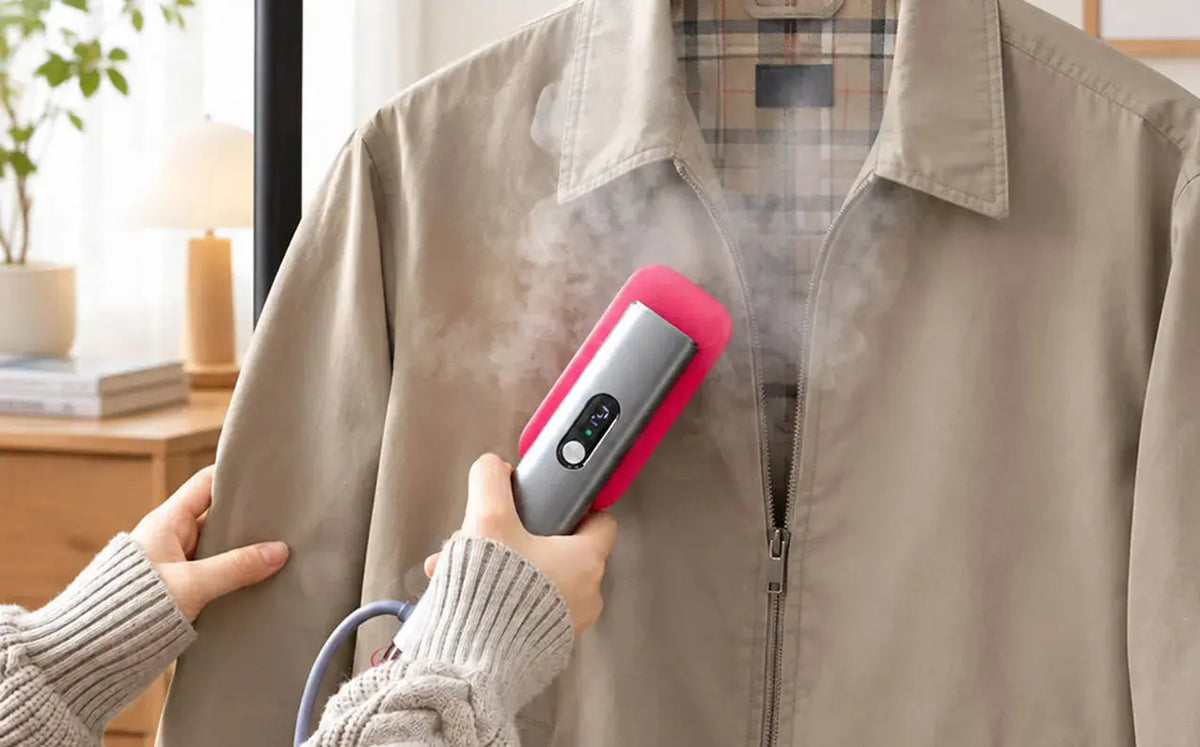

Travel Steamer for Quick Touch-Ups: How I Finally Figured Out What’s Worth Packing
I used to have a pretty obvious weakness when shopping for travel gear:
If it was small, I assumed it would be good.
Then I’d buy it and find out that, sure, it was small—but it also had a few problems of its own.
Some took so long to heat up that I started wondering if they were ever going to get around to steaming. Others had water tanks so tiny that I’d run out of water halfway through one shirt. And then there were the so-called “travel” models that looked perfectly ready for international trips—until I got overseas and realized the voltage wasn’t compatible.
So these days, I keep my travel-steamer checklist pretty simple.
I don’t ask:
“Which one has the most features?”
I ask:
“Is this actually going to work for the way I travel?”
Those sound like similar questions. They’re not.

I Don’t Need the Most Powerful Travel Steamer. I Need One That Fits the Trip.
If you search for travel steamer for quick touch-ups, it’s easy to fall into the “more power must be better” trap.
I used to think that way, too.
But if I’m just trying to freshen up a shirt before breakfast or smooth out a dress before dinner, I’m not trying to steam my entire wardrobe.
I want something I can grab, use, and put away without turning it into a whole project.
It should heat up quickly, feel comfortable in my hand, and take care of the wrinkles that actually matter.
That’s what I want from a travel steamer.
It doesn’t need to replace the full-size steamer sitting at home.
It just needs to handle the problem in front of me:
I’m traveling. I have limited space and limited time. My clothes are wrinkled. I need to wear them soon.
That’s it.
If You’re Trying to Keep Your Carry-On Light
When I’m traveling with one carry-on and one backpack, every little bit of extra weight starts to matter.
Half a pound doesn’t sound like much until you’ve already packed shoes, chargers, toiletries, a laptop, and all the other things you convinced yourself you’d “probably need.”
That’s why weight matters to me when I’m choosing travel gear.
The NESUGAR G2 Pro, for example, is currently listed at about 0.8 lb, supports 100–240V, and heats up in roughly 15 seconds.
That’s exactly the kind of setup I’d want in my carry-on.
Because the biggest problem with travel gear usually isn’t that it lacks power.
It’s that it takes up enough room—or adds enough weight—that you eventually decide to leave it at home.
And if I have to stand over my suitcase for three minutes asking myself whether something deserves a spot, it has already lost half the battle.
If Wrinkled Clothes Drive You Crazy
Then there’s the other kind of traveler.
The person who notices one obvious crease in a shirt and can’t stop seeing it.
Yeah. Sometimes I’m that person.
It matters even more on a business trip.
If I’m meeting a client, attending a conference, or going somewhere a little more formal in the evening, I don’t want to wear something that looks “good enough.”
I want to look put-together.
That’s when a fast heat-up time really matters.
The NESUGAR G5 Pro is designed for quick touch-ups, with the product page listing roughly 15 seconds to heat up and positioning it for shirts, dresses, and everyday clothing.
I’m not expecting it to replace a full-size garment steamer.
That’s not really why I’d buy it.
The useful part is much simpler:
You spot a wrinkle at the last minute, and you can actually do something about it.
That’s what I want from a quick-touch-up steamer.

If You’re Steaming Several Outfits
This is where I’d change my priorities.
If I’m going to a wedding, traveling for work, or spending a week on the road, I might have several outfits to deal with.
Shirts.
Dress pants.
Jackets.
Dresses.
Maybe some heavier fabrics.
At that point, I’m not as interested in finding the absolute lightest steamer.
A tiny water tank and limited steam output can get annoying fast when you’re constantly stopping to refill it or going over the same area again and again.
That’s when a larger tank and stronger steam output start to earn their place in my suitcase.
The NESUGAR G5 Pro, for example, is currently listed at 1500W, with a 200ml water tank and 100–240V support.
That’s what I’d rather have when I’m steaming several outfits in a row.
So these days, I follow a pretty simple rule:
One garment? Prioritize weight and convenience.
Several garments? Pay more attention to water capacity and steam performance.
There’s no reason to bring a high-powered steamer for one wrinkled shirt. And there’s no reason to bring an ultra-light model if you’re trying to get an entire business wardrobe ready.
Traveling Internationally? Check the Voltage First.
This is one detail I pay much more attention to now.
Just because a product is marketed as a “travel steamer” doesn’t mean it automatically works everywhere.
Check the voltage rating on the device itself.
If it says 100–240V, it’s designed to work across that voltage range, which can make international travel a lot easier.
But there’s an important distinction:
A plug adapter is not a voltage converter.
A plug adapter answers:
“Can I physically plug this into the outlet?”
A voltage converter answers:
“Is the electricity from that outlet compatible with this device?”
Those are two completely different questions.
NESUGAR’s travel guidance also separates the two and recommends checking the voltage rating on the actual device rather than assuming that the word “Travel” on the packaging means it’s internationally compatible.
So if I’m traveling from the U.S. to Europe, I’m not just asking:
“What plug adapter do I need?”
First, I’m asking:
“What voltage does my steamer support?”
Then I figure out the plug.
That order matters.
Is a Bigger Water Tank Actually Better?
I used to think the answer was obviously yes.
Now I don’t.
The right tank size really depends on how you plan to use the steamer.
The G2 Pro has a 75ml water tank, which makes sense for a lightweight, quick-touch-up setup.
The G5 Pro has a 200ml tank, which makes much more sense if I’m planning to steam several garments in one go.
The G2 Pro is also listed at around 0.8 lb with a roughly 15-second heat-up time, so the difference between the two becomes pretty clear.
I don’t look at that and think:
75ml good. 200ml better.
I ask:
How much am I actually going to steam?
If I’m fixing one shirt before heading downstairs for breakfast, I don’t need a huge tank.
If I’m getting five outfits ready for a week of business meetings, I’ll happily take the extra capacity.
That’s one of the biggest lessons I’ve learned with travel gear:
A bigger number doesn’t automatically make something better. It’s better when it fits the way you actually use it.

I Don’t Try to Get Every Wrinkle Out Anymore
This might be the biggest change I’ve made.
I used to steam everything from the collar all the way down to the hem.
Now I don’t bother.
I usually focus on five areas:
The collar, shoulders, chest, sleeves, and hem.
Why?
Because those are the areas people are most likely to notice.
A few natural wrinkles elsewhere? I can live with that.
But a big crease across the chest or a collar that looks like it just came out of a suitcase pocket?
That’s noticeable.
So my approach now is simple:
Fix the areas that make the biggest visual difference first.
That’s also why I think a travel steamer works so well for quick touch-ups.
I’m not trying to make a shirt look like it came straight from the dry cleaner.
I’m just trying to go from “I just opened my suitcase” to “I’m ready to walk out the door.”
Test It Before You Pack It
One thing I strongly recommend: don’t make your first attempt at using a new travel steamer in a hotel room in Paris.
I learned that one the hard way.
Test it at home first.
See how long it takes to heat up.
Check whether the steam output feels consistent.
Figure out how the water tank works.
Make sure it isn’t leaking.
See how it feels in your hand.
And make sure it’s easy to pack back up.
If you’re traveling internationally, check the voltage one more time.
Because once you’re actually on the road, you probably won’t feel like reading a ten-page instruction manual.
Especially at 8:30 in the morning before a business meeting.
At that point, you just want the thing to work.
How I’d Choose a Travel Steamer Today
If I were shopping for one today, I’d match the steamer to the trip rather than trying to find one “best” model for everyone.
Carry-On Only
I’d prioritize a lightweight design.
The less space and weight it takes up, the more likely I am to actually bring it.
Mostly Dealing With Last-Minute Wrinkles
I’d look for a fast heat-up time.
I’m not trying to steam an entire wardrobe. I just want to make a shirt or dress look presentable in a few minutes.
Business Travel With Multiple Outfits
I’d give up a little weight in exchange for stronger steam performance and a larger water tank.
When you’re steaming several outfits in a row, that extra capacity can make a real difference.
Frequent International Travel
I’d put voltage compatibility near the top of my list.
A 100–240V steamer can be much more convenient for international trips, although I’d still check the plug type at the destination.
Occasional Trips and Mostly T-Shirts
Honestly?
You might not need one.
That may not be the answer you expect from a buying guide, but I think it’s the honest one.
If your clothes don’t wrinkle much and you rarely travel for business, weddings, or other dressier occasions, I wouldn’t add another gadget to my suitcase just because I might use it someday.
Suitcase space has value, too.
So What Kind of Travel Steamer Do I Actually Like?
Not necessarily the most expensive one.
Not the one with the longest feature list.
And not even necessarily the one with the highest steam output.
I like the one that works when I actually need it.
I notice a wrinkled shirt five minutes before I need to leave, I pull out the steamer, and it fixes the problem.
That’s what matters to me.
Maybe that means a roughly 15-second heat-up time.
Maybe it means a lightweight 0.8-lb design.
Maybe it means 100–240V compatibility for international travel.
Maybe it means a compact 75ml water tank.
Or maybe I’m better off with a 200ml tank because I’m steaming several outfits at once.
The numbers themselves aren’t the point.
What matters is whether they fit the way you travel.
If I’m only touching up one garment, I want something light, fast, and simple.
If I’m steaming several business outfits, I want enough steam and water capacity to get through them without constantly stopping.
If I’m traveling internationally, voltage compatibility comes first.
That’s how I think about a travel steamer for quick touch-ups now.
It’s not about turning travel into laundry day.
It’s about making sure that when the trip is already busy, cramped, and exhausting, wrinkled clothes don’t become one more thing I have to deal with.
The flight can be delayed.
The suitcase can be a mess.
The hotel room can be tiny.
But when I walk out the door, I’d still like my shirt to look like I knew what I was doing.