
I have been in the watch industry for over a decade. Starting from helping customers adjust their watch straps behind the counter, to later being responsible for store image presentation, VIP maintenance, and accompanying clients to business events, I gradually developed a habit — wherever I go, I always carry a small portable steam iron with me. Some people think it’s odd that a watch salesperson would be so focused on clothing care. I’ve seen too many cases of expensive watches paired with crumpled shirts, and I know how small details amplify the whole look. A poorly-pressed shirt can make even the finest watch look out of place.
In the store I serve as both an advisor and someone who manages the overall image. From the moment the store opens I check the lighting, display cases, bracelet condition, dust on products — and even whether each colleague is dressed suitably. We don’t sell ordinary items; we sell luxury wristwatches that represent taste and status. On a customer’s first visit, their impression of you, the product and the brand is shaped by those small details.
After working in this environment for years, I notice wrinkles almost instinctively. It isn’t a compulsion — it’s that customers can read small creases as a lack of professionalism. I once rescued a colleague’s shirt with a steamer during a rush, and I’ve helped VIPs straighten suits backstage at brand events. Over time I grew to prefer handheld steamers and picked up a lot of practical know-how.
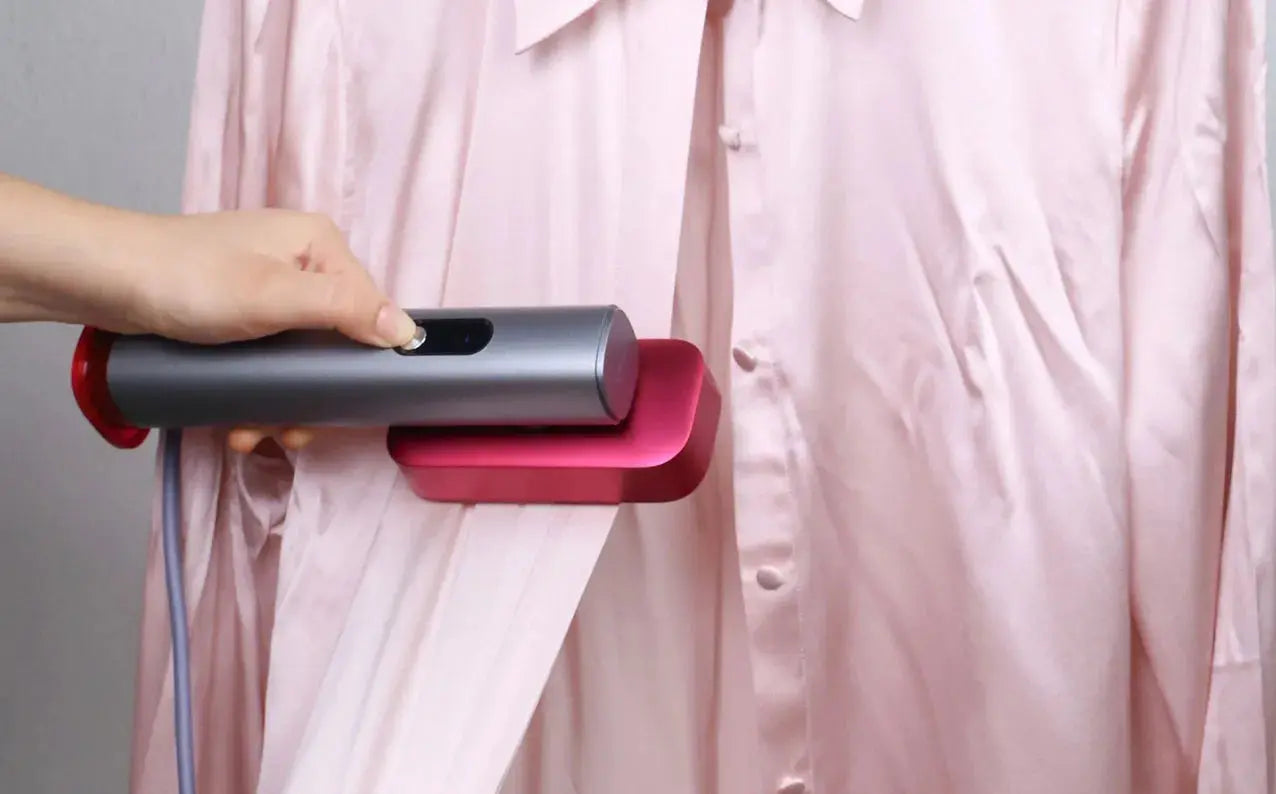
One experience convinced me that carrying a steamer isn’t an exaggeration but an industry necessity. It happened at a wristwatch media cocktail party in Paris. I was accompanying a very important collector. He was easygoing, but his clothes had been folded in a suitcase and two creases had formed across his chest. At the backstage mirror he frowned and said, “If I go out like this my friends will roast me.” The venue was bright and cameras were flashing everywhere. I had to get his clothes presentable in under five minutes. Luckily, I had a portable steamer on hand. A few gentle passes with the steamer smoothed those stubborn creases away.
The collector looked at his suit and said, “Now I see why people in the watch industry are obsessed with details.” At that moment I realized professionalism can be a small, almost invisible action. Those small actions form industry standards and explain why people place their trust in you.
So why switch from an iron to a dress steamer? When I was younger I used a traditional iron. As I started attending more events, I learned one key principle: in professional settings you need the ability to get ready quickly, not a slow, cumbersome prep routine.

I chose a steamer for three simple reasons, all based on experience:
It’s much gentler than an iron — especially on high-end fabrics. I deal with everything from winter wools to summer silks. High-end materials tend to compress and crease easily. A traditional iron, pressed too firmly, can leave unwanted shine. Steam lifts the fibers with moisture so they relax back into shape without changing texture or sheen. When arranging garments, steaming a hung shirt gives a more natural, three-dimensional result than a flat iron.
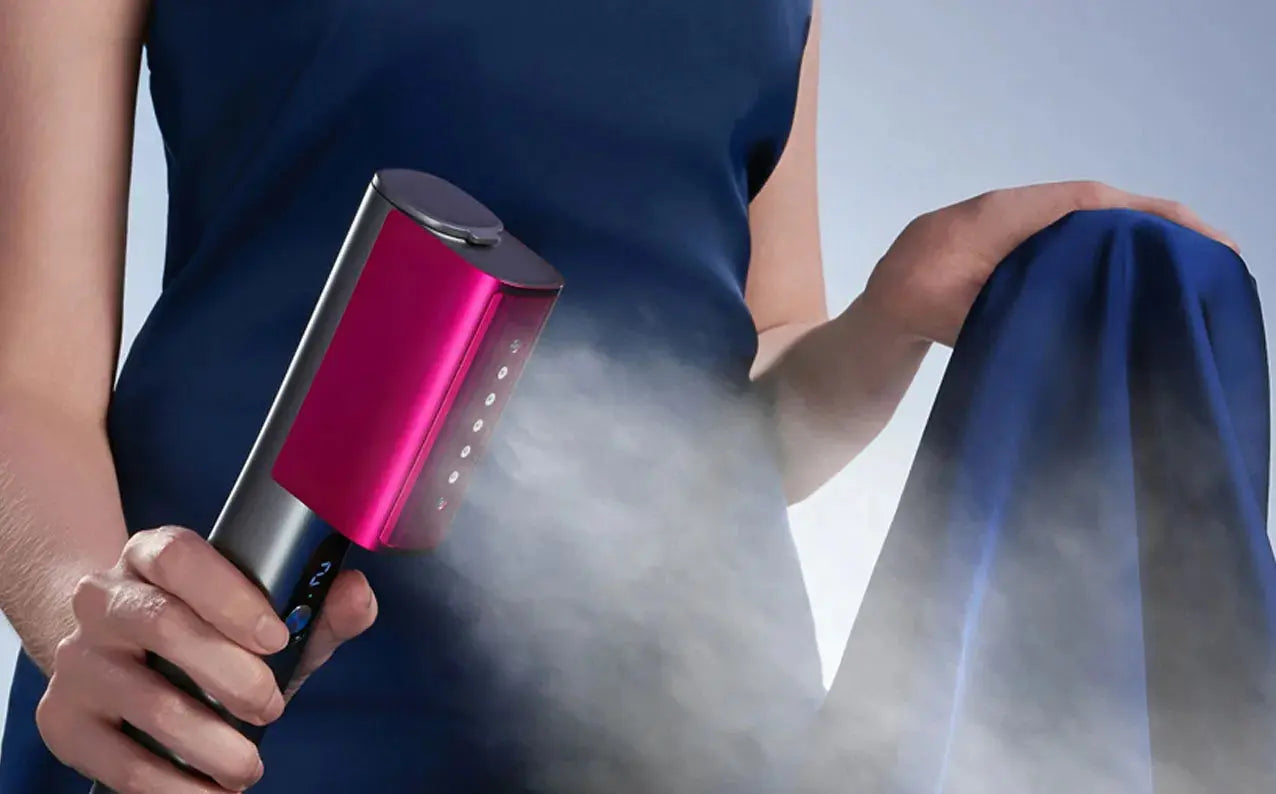
It saves time — crucial for someone like me who’s often called on to help. In-store I often have to get a colleague’s or model’s clothes ready in five minutes. A steamer with quick-heat is a lifesaver — a 15 seconds of warm-up and it’s ready.
It is more portable — I travel frequently throughout the year and need to be light in weight. I always keep tableware, cleaning cloths, display tools in my suitcase for trade shows, media events, and regional training sessions... but the steamer has to be light, or I won’t bring it. Some designs are specifically made for travel: compact size, support for international voltages, adjustable steam modes, and no special socket positioning required. I chose a portable model once when I was rushing to catch a flight and my checked luggage was overweight — that decision stuck.
— Now let's move on to the "Practical Tips" section. These are the experiences that I have verified multiple times and can be relied upon. —
This section might be the most practical. I will try my best to write it in a sincere and straightforward manner, just like when I give on-the-spot guidance to new employees in the store.
How to achieve a "professional level" effect with the dress steamer?
Step 1: Make the clothes "stand up" — This is more important than the steam itself.
No matter what brand or model it is, my first rule is always: Hang the clothes properly so that the fabric can hang naturally. This is equivalent to completing 40% of the organizing work for you. The method I use most frequently in the store is: The shirt is hung on the wooden hanger. The suit is hung on a shoulder-shaped hanger. The pants are held vertically with clips. Let gravity first shape the fabric, and then the steam merely "finishes the job".
Step 2: Keep the steam 2 to 5 centimeters away from the clothes.
This distance is crucial. It should be neither too close (which would cause water droplets to form) nor too far (which would be ineffective). Usually, the way I determine the distance is quite simple: "The steam just touches the fabric, but the nozzle does not touch the fabric surface." If it's a lightweight fabric, such as silk, I would keep it at 5–7 centimeters. The further away, the safer.
Step 3: Be slow, not fast.
{The most common mistake made by beginners is to sweep the steam across quickly like cleaning the floor. However, in fact, the steam needs to stay for a while to allow the fibers to loosen. My rhythm is approximately: From top to bottom Push it inch by inch downwards Each position stays for 0.5 to 1 second. Even with a dark-colored shirt, there won't be any localized damp marks.}
Step 4: The stubbornly stubborn "professional approach" — hands in coordination
This is what I learned from Old Chen (the most experienced consultant in our store). He taught me: "Drying clothes involves one hand for steaming and the other hand for shaping." For example, when it comes to the horizontal pleats on the chest of a shirt, I would: The left hand gently pushed the fabric slightly to straighten it from the inside of the garment. The right hand allows the steam to glide over the fiber texture in that direction. During the steaming process, gently pull your hand downwards. The wrinkles will naturally disappear after being loosened. This technique may seem insignificant, but once mastered, your clothes will never have the embarrassing problem of remaining wrinkled for hours.
Step 5: After steaming, do not put it on immediately. Let it "rest" for one minute.
After steam enters the fabric, it takes some time to evaporate. Every time, I will let the clothes "breathe" for 30 to 60 seconds. This way, the fabric state will be more stable and the clothes won't get wrinkled again due to moisture.

Professional care techniques for different fabrics (high-frequency practical examples)
I have taken care of hundreds of customers' clothes and dealt with various materials. Here is the "most reliable usage" for you directly.
Silk
Stay a little farther away. Reduce the steam flow. Never stay for too long. Silk is most prone to "water shadows", so it's safest to keep it at a distance.
Wool / Suit Fabric
This is the most exhausting experience of my career. Use the high-pressure steam. While steaming, brush along the grain with a brush. Allow the fabric to regain its firmness and straightness by itself. The shoulder designs of many high-end suits are supported by the tension of the fabric. Steam can maintain the original structure better than an iron.
Cotton and linen
High water absorption capacity. Need a higher temperature or more steaming cycles. But cotton and linen have one advantage: they "like to be steamed". Usually, just one or two steams will be enough to make them stand up.
Leather (especially the genuine leather straps for watches)
This is an important point that must be mentioned: Leather should not come into contact with steam. Whether it's a genuine leather strap, suede shoes or a leather jacket, high-temperature moisture will alter the fiber structure, causing hardening, deformation and even discoloration. As a watch seller, I have seen too many cases where the watch straps have deformed due to moisture. That's not a nice kind of aging. So when I'm doing the laundry, I always do the following: Take off the watch. Or at least wrap it with a sleeve. Protecting a watch is just as important as protecting clothes.
How to choose a truly practical portable steam device? (From the perspective of a long-term user)
I don't like the "overly complex parameter-based" recommendation method available on the market. It's too vague. What I value more is whether it can help me solve problems in real-life situations. The following are the judgment criteria that I have summarized after numerous business trips and daily usage:
The heating speed must be fast.
Many models are labeled as having "rapid preheating", but not many actually manage to produce strong steam within just a few seconds. In the backstage or display area, I require "instant response", so the quick heating capability is my top priority consideration. Nesugar has several portable models that perform well. They are foldable, quick to heat up, and have stable steam output. Such designs are very suitable for the needs of my profession.
The steam must be stable and must not spray water.
This is extremely important because dark-colored clothes are most susceptible to water droplets. I usually let the steam generator operate for 2–3 seconds first, then check if the nozzle has: Water droplets remain. The steam is weak and diffuse. The volume fluctuates up and down. These are all the criteria that determine whether it can step in and save the situation in important occasions.
A balance should be struck between capacity and weight.
I often need to carry a toolkit, which contains watch straps, watch cloths, watch boxes, watch removal tools, gloves, and other materials... The steam generator must be lightweight, but it also needs to have sufficient power supply. Usually, I prefer: The water tank is not very large, but it is sufficient to steam two or three pieces of clothing. Compact design, ideal for travel. Durable in structure, not prone to damage during transportation. Nesugar has some designs specifically for travel-focused models, and it was these reasons that drew my attention to them.
International voltage standardization is a must-have.
Every year, I travel to different countries to attend training sessions and events. If the steam generator doesn't support international voltages, I simply won't bring it along. Therefore, I will prefer to choose the model that is marked as "100–240V".
Easy Cleaning and After-sales Service
This is not an advertisement. It's a real pitfall I experienced myself. The most common problem with steamers is: scale buildup blocking, the steam flow has weakened, the preheating process has slowed down. Can it be easily cleaned? Can the accessories be purchased? Is the after-sales service transparent... These factors will determine whether it can accompany me for more than a year. The Nesugar website provides information about transportation, returns, and warranties. When I first saw it, I felt relieved — as an advisor, I need "confidence" when recommending to clients, and transparent services can give me this confidence.

A small incident that I will never forget (displaying professional details and professional judgment)
Once, a man who was a regular customer of ours was going to attend an investor meeting. He brought two watches and asked me to help him choose which one to wear that day. I picked out the business-style watch with a steel band for him, but when he changed his clothes, I noticed that the khaki pants he bought new had a clear horizontal crease due to the packaging folding. Half an hour later, he was clearly already feeling a bit anxious. I said no more words and walked to the backstage to take out my own portable steamer. I asked him to stand in front of the dressing mirror and gently straighten the lower edge of the pants. I slowly steamed from the bottom of the pants towards the thighs, while using my other hand to unfold the fabric pattern. In less than two minutes, that crease completely disappeared. He stared at his reflection in the mirror for a few seconds, then said to me: "You watchmakers, you actually know more about clothes than my wife does!" That wasn't praising me; rather, he realized a fact: The true professionalism is not "selling watches", but helping the right people present their best selves at the right occasions. And the dress steamer, throughout my career, was precisely the tool that consistently helped me get customers "back to their best".
Finally, I'm sending you a "collectable" list of practical tips. This list is the result of my repeated experiments over many years in front of the counter, in the back office, in hotels, and in airport corridors:
Must-have items for business trips
Portable steam generator compatible with international voltages
A soft-bristled brush
Microfiber cleaning cloth (can gently absorb moisture after steaming)
Remember the four rules during use.
Let the clothes naturally straighten out (gravity is always the best friend)
Don't press the steam nozzle too closely against the clothes.
Take your time and don't rush through it.
After steaming, let the clothes "rest" for one minute.
When it appears together with the watch, you must pay attention.
Try to summarize the table. Especially the genuine leather strap. If it is not possible to remove the watchband, cover the watch completely with the cuff. (I have seen too many cases of watch bands deformed due to steam. That was truly heartbreaking.)
The best practices for different materials
Silk: Long-distance, low-temperature steam
Wool/Suit: Matched with a brush
Cotton and linen: Steam for a few more times
Leather: Never steam it.

Final Note:
Keeping clothes neatly folded is not only a professional attitude but also a way of life. As a long-time consultant at a watch store who has been on the front lines for many years, I have witnessed countless moments where something was "just a little bit off" but still close to perfection. And what was often "just a little bit off" was not the watch itself, but the condition of the clothes. The dress steamer is not merely a "tool" to me; rather, it is a form of personal discipline that I carry with me at all times. It enables me to maintain a neat and tidy appearance during busy, chaotic, and rushed days; and it also helps me assist clients in presenting their best selves at critical moments. If you also frequently need to make an appearance at important events, or if you, like me, have a "professional obsession" with image, then you will surely understand why I consider a small portable steam device to be a daily necessity.