
Steam iron is never a supporting role: The secret to making an online store model's clothing look great on camera
Over the years as an online store model, I gradually developed a somewhat obsessive habit - whenever I see a piece of clothing, I will spend two seconds staring at its wrinkles. Even when I'm just accompanying a friend on a shopping trip, I can't help myself imagining how the lines of this garment would be smoother if treated with a steam iron, whether the collar could be more upright, and whether the chest line could be more vibrant.
Because in front of the camera, I know better than anyone else: The condition of the clothes can determine the final atmosphere of a photo.
Why do I have such a strong reliance on the steam iron? Because it has saved too many "unfinished" situations.
The shoot was nothing romantic. It was just a series of hectic shoots on the set, an endless lack of time, and a car full of clothes that were still not completely laid out.
The most memorable experience for me was shooting a wool coat in winter. When the sample garment was taken out of the box, the cuff was pressed into a large crease. The photographer had already set up the lights. I was standing in the cold wind wearing high heels, trembling all over. But that crease felt stubborn, as if nothing I did could flatten it. Finally, it was the small-scale steam iron equipment on site that saved the day - once the steam was applied, the lines of the coat loosened, and the shoulder line stood upright again. At that moment, I truly felt that I "could shoot it now".
That was also the first time I realized:
A steam iron is not a tool; it is the invisible makeup artist in front of the camera.

Before the official start, the preparations I will definitely make (this is a professional habit)
First, I will touch the fabric with my hands
I don't need to look at the label. Just by touching it, I can tell if it needs to be treated gently.
With time you learn to read a fabric by touch — the way it gives under your fingers tells you how to treat it.
Woolen, knitted, silk, synthetic fibers, cotton and linen... Each texture is telling you its temperament. Over time, you will develop an instinct, just like a chef who can tell how to cook meat by touching it.
Check that the hanger is properly positioned
The clothes couldn't be hung properly, and even after being treated with a steam iron ten times, they still didn't get clean.
I will straighten the shoulder line, gently pull the hem of the dress together, and let the fabric fall naturally. Many people skip this step, yet letting the garment hang naturally removes a large portion of surface wrinkles.
The on-set space must be clean, dry and well-ventilated.
In the shooting room, there are usually all kinds of clothes and lamps piled up. If you're not careful, the steam will rebound onto the lens or the fill light. I habitually adjust my position, leaving a small space for the steam iron. { That's my battlefield.
The actual process I follow for handling clothes (this process is roughly the same for each piece of clothing)
First, steam them to loosen the fabric and "wake it up"
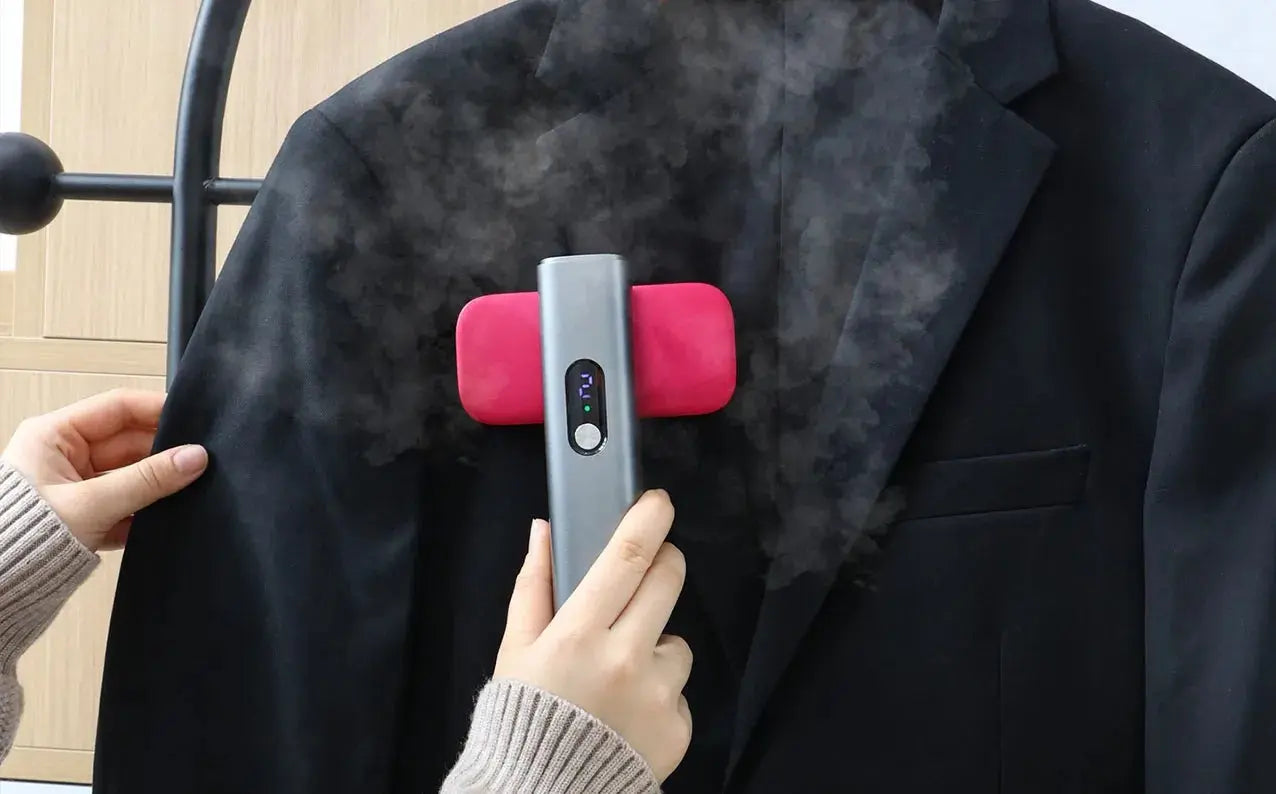
I prefer to use a sweeping motion, from the shoulders to the hem, from the center to the sleeves. The steam acts like a warm-up for the fabric, allowing it to regain its breathability.
Some people think that a steam iron is "the closer the better", but in fact, that is the most likely to cause water damage. What is needed is a gentle, unhurried, and patient approach.
Reshaping - Creating shape for the lines
Once steamed, the fabric relaxes and responds to gentle shaping.
At this moment, with just a gentle press, even the slightly stubborn cotton and linen can be made to form clean vertical lines. The lapel of the coat, the pleats of the skirt, the cuffs of the suit... Every part requires a bit of sculptural patience.
Detail Handling - Here lies the key to determining the "luster" of a piece of clothing.
I often look into the mirror to observe:
- Is the collar standing up?
- Is the sleeve smooth?
- Is the pocket position level?
- Is there any visible small wave at the hem of the skirt?
The camera lens is always more "sharp-tongued" than your naked eyes. Small flaws invisible to the naked eye become obvious under studio lights. Many small imperfections that are invisible to the naked eye are magnified infinitely when exposed to the studio lights. At this moment, a nimble little steam iron head can enhance the overall appearance more effectively than any makeup.

As an online store model, I have several very practical requirements for the equipment I choose.
It should be lightweight (because I often have to stand and organize the clothes)
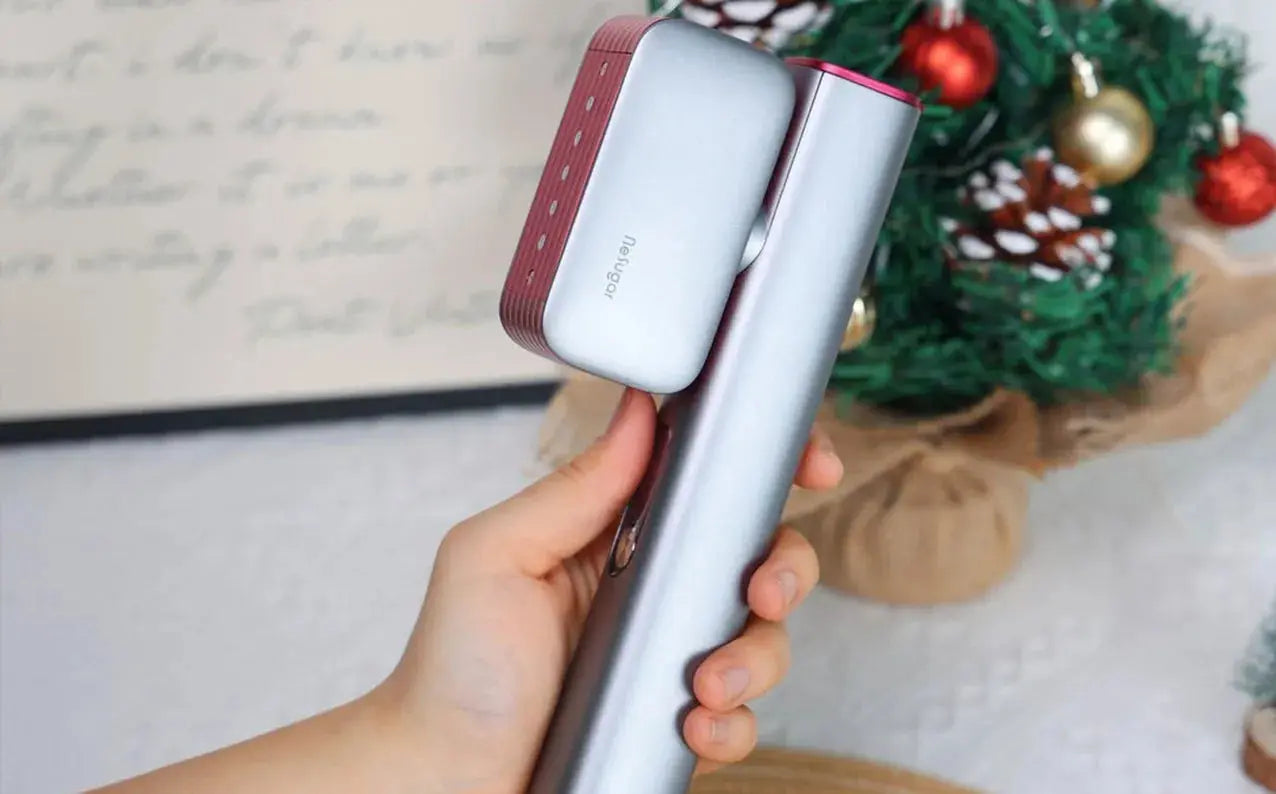
Sometimes I have to change twenty sets of clothes in a day. If the steam head is too heavy, my arms will soon become sore. Portable steam irons are a lifesaver for people like me who need to move around frequently.
The steam must be stable and continuous.
The 30 seconds before the shoot is like a race against time.
The steam fluctuates wildly, making it impossible for you to keep a steady rhythm and the fabric cannot relax evenly. I am particularly concerned about whether the steam iron can remain stable throughout the process, as this determines the speed of the ironing.
The temperature should rise quickly.
Often, it was the photographer who was giving the countdown: "Take this photo in five minutes."
Fast, that is professionalism.
Does not require fetching water and is less prone to scaling.
I often go out to take photos. The water quality in different hotels varies greatly. Some equipment really starts to "sneeze" easily due to hard water; some are relatively stable. A steam iron that can adapt to different environments is always more convenient to use.
The safety must be high enough.
The scene was so busy that sometimes I would forget that I was plugged in just by looking around. Devices with automatic power-off features would give me a great sense of security.
Notes on the Feel of Different Fabrics
After years of experience, I have developed some fixed processing methods for these fabrics and would like to share them with those who need them:
Silk
Steam always takes precedence.
A little farther away
Use fingers to gently pull
The most beautiful aspect of silk lies in its luster. If it is scorched to become shiny, it is ruined.
Wool, knitting
Medium temperature
Press lightly
Avoid pulling
Wool and knits can be delicate — they’ll change shape if you pull too hard.
They are like people who are prone to shyness; they will change shape when being pulled.
Cotton and linen
High temperature
More steam, please.
Drink plenty of water and make frequent adjustments.
Cotton and linen are stubborn, but they become very pliable after being tamed by a steam iron.
Synthetic fibers
Don't make the temperature too high.
Steam will do.
The focus is on restoring the lines.
Once the synthetic fibers are stained, it is very difficult to remove the stains.

The genuine incidents that occurred during the shooting (and this is why I attach such importance to steam)
Once for a dress lookbook shoot, the skirt hem was made of very lightweight chiffon. When the lights were turned on, all the small pleats seemed to have expanded ten times their original size. The photographer frowned, and I could feel the tension in the air.
I picked up the portable steam iron I had with me, steaming while gently smoothing the skirt down with my hand, over and over again. That kind of sheer fabric really requires a slower and softer process.
The image that emerged from the camera was so light and airy, resembling clouds blown by the wind. The photographer said, "That operation just now was even more crucial than adding light."
At that moment, I once again confirmed:
A model's attention to clothing often reveals their professionalism.
A daily checklist that I repeat every day (for you to follow)
- Touch the fabric → Assess the temperament
- Check the label → Determine the temperature and method
- Hang the clothes straight → Let the fabric hang naturally
- First steam then press → Increases success rate
- Check the neckline, cuffs, hemline and pockets.
- Let it cool for three minutes before putting it on → To prevent further wrinkling
- Drain the water from the steam iron after using it each day → Extend the lifespan
This process may seem rather trivial, but once you get into the habit of following it, you'll find that your clothes always look more "attractive" than others'.
Conclusion: The condition of your clothes determines how you present yourself to the world.
Every day when I'm in front of the camera, the one thing I understand best is this:
Whether a person is confident when standing in front of the camera, the clothes always account for at least 30% of the factor.
Using a steam iron may seem trivial, but it is actually a way of implementing "professionalism" down to the smallest details.
I share these not to showcase any particular skills, but because I truly understand that these methods can help you be more composed and efficient in real life, in photos, and at any moment when you need to present a polished image.