
Portable Hand Steamer for Clothes: How I Choose a Small Steamer That Actually Works
I used to think choosing a clothes steamer was pretty simple: find one with strong steam and call it a day.
Turns out, it’s not quite that simple.
After trying a few different models, I’ve realized that a portable steamer can have plenty of steam and still be a pain to use.
If it’s heavy or awkward to hold, I might use it twice before deciding it’s more trouble than it’s worth.
A big water tank sounds great, too—until I’m already running late and waiting for the thing to heat up.
Then there’s the opposite problem. A steamer can be tiny and lightweight, but if I have to refill it every few minutes, I’m going to get annoyed pretty quickly.
So these days, I look at the whole experience rather than getting hung up on one impressive specification.
Is it comfortable to hold?
Does the steam come out steadily?
How quickly does it heat up?
Is the tank large enough for the clothes I actually need to steam?
Will it fit easily in a suitcase?
And can I use it safely on the fabrics I wear most often?
Those details are what determine whether a small steamer becomes something I reach for all the time—or something that gets shoved into the back of a closet and forgotten.

What Is a Portable Hand Steamer for Clothes?
The basic idea is pretty simple.
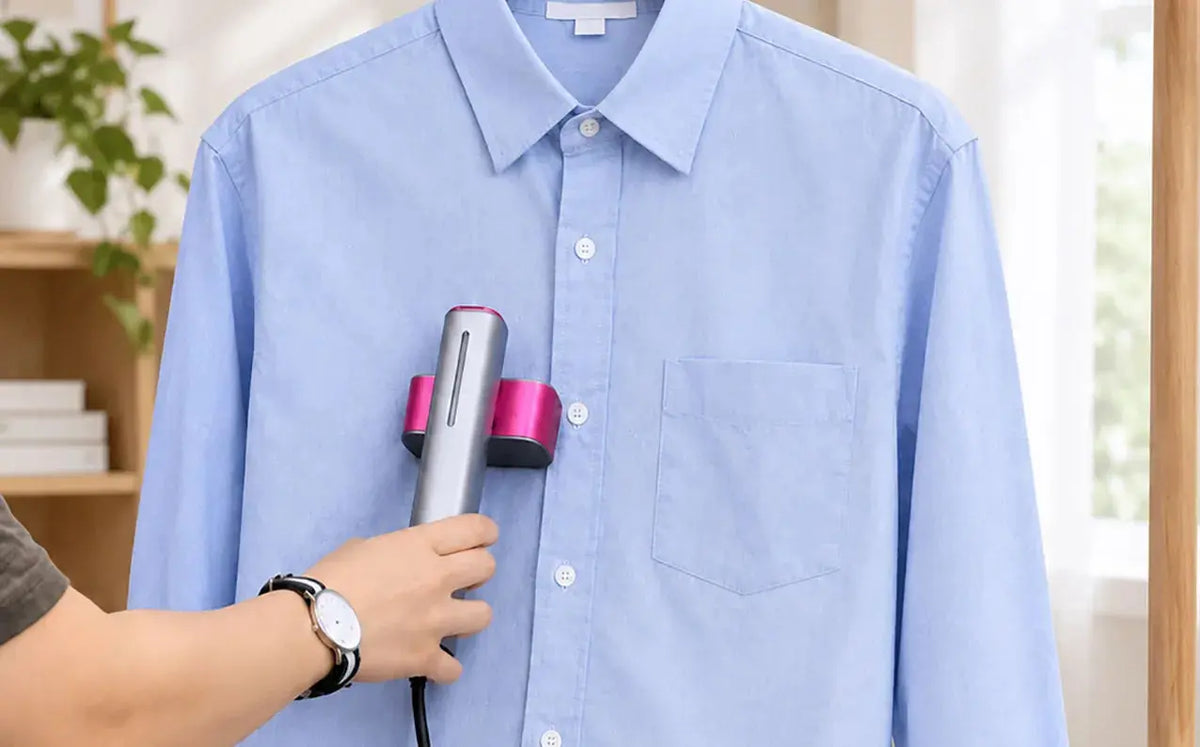
A clothes steamer heats water, turns it into steam, and sends that steam through a nozzle. When the steam reaches the fabric, it helps relax the fibers and release wrinkles.
The biggest difference between a steamer and an iron is really how you use them.
With an iron, you normally lay the garment flat and use heat and pressure to smooth it out.
A handheld steamer lets you work on clothes while they’re hanging.
That’s a big deal when I’m getting dressed in a hurry.
Most of the time, I’m not trying to make a shirt look like it just came out of a luxury department store display. I just want the shirt I pulled out of my closet or suitcase to stop looking like a cat spent the night sleeping on it.
That’s where a small clothes steamer earns its place.
It’s quick, convenient, and doesn’t require me to drag out an ironing board every time I find a wrinkle.
Why Portability Matters More Than I Expected
“Portable” sounds like a pretty basic product feature, but with a clothes steamer, it can make a surprisingly big difference in how often you actually use it.
If a steamer is too large, I’ll probably put it in a closet.
Then, when I need it, I have to take it back out, find an outlet, find somewhere to put it, fill it with water, and get everything ready.
If an ironing board is involved, the whole thing starts feeling like a project.
Eventually, I’m standing there looking at my wrinkled shirt thinking:
“Honestly, it looks intentional.”
That’s one reason I’ve come to appreciate genuinely compact handheld steamers.
Portability isn’t about making a product look cute. It’s about making it easier to use.
When I’m shopping for one, I pay attention to three things right away: the size, the handle, and where the water tank sits.
Size and Shape
A long or bulky body can make storage awkward. It can also make one-handed steaming less comfortable.
I want something I can grab, use, and put away without having to think about it.
The Handle
The handle can make a bigger difference than you might expect.
Two steamers can weigh exactly the same but feel completely different in your hand depending on how that weight is distributed.
A well-balanced handle can make several minutes of steaming feel easy. A poorly balanced one can leave my wrist working harder than it needs to.
Water Tank Placement
The position of the water tank matters for the same reason.
If most of the weight sits toward the front, my wrist has to work harder to keep the steamer balanced.
So I don’t just look at the number on the scale.
The question I really want answered is:
Will I still be comfortable holding this thing after steaming an entire outfit for ten minutes?

How Much Should a Portable Steamer Weigh?
Weight is one of those specifications that’s easy to overlook.
A clothes steamer isn’t sitting on a countertop while you use it. You’re holding it, moving it up and down, and sometimes keeping your arm raised for several minutes.
That extra weight becomes much more noticeable over time.
For example, the Nesugar G3 Pro is listed at around 380 grams, or about 0.84 pounds. For a compact steamer designed with travel in mind, that’s a fairly manageable weight.
But I wouldn’t automatically assume lighter is always better.
If a machine gets extremely light, something else may have to give—water capacity, heating components, or steam performance, for example.
What I’m really looking for is a good balance between weight, steam performance, and water capacity.
For a travel steamer, I’ll usually lean toward lighter.
For something that stays at home, I’m willing to accept a little extra weight if it feels well balanced and delivers the performance I need.
Preheat Time: The Difference Between Useful and Annoying
Heat-up time is another specification that matters a lot more in everyday life than it might seem on a product page.
There’s nothing quite like this:
My clothes are already hanging.
I’m ready to go.
And the steamer is still sitting there taking its sweet time heating up.
Getting ready in the morning already feels like a race against the clock. I don’t need my clothes steamer testing my patience too.
Some compact models can be ready in around 15 to 20 seconds.
For example, the Nesugar G5 Pro is rated for about a 15-second heat-up time, while the G9 Pro is listed at around 18 seconds.
For quick touch-ups, that kind of speed is genuinely convenient.
Still, I wouldn’t judge a steamer by its fastest advertised heat-up time alone.
What matters more is how long it takes from a cold start until it produces usable, steady steam.
That tells me a lot more than one number printed on the box.

Steam Output Matters More Than a Big Number
If a steamer claims an impressively high temperature, I’m not automatically impressed.
A higher temperature doesn’t necessarily mean it will remove wrinkles better.
What I really want is steam that comes out steadily instead of sputtering, stopping, and starting every few seconds.
For everyday use, I look for steam that is:
- Consistent
- Steady
- Evenly distributed
- Reliable during longer sessions
- Appropriate for different fabric weights
A lightweight shirt and a thick cotton jacket obviously don’t need exactly the same amount of steam.
That’s where adjustable steam settings can be useful.
A lower setting can make sense for lighter fabrics, while a stronger setting can help when I’m dealing with heavier material or stubborn wrinkles.
I’d much rather have useful control over the steam than simply chase the biggest output number on the box.
Choosing the Right Water Tank Size
The water tank is one of those areas where bigger isn’t necessarily better.
A larger tank usually means more steaming time between refills.
But it can also make the steamer larger and heavier.
For a full-size standing garment steamer, a large tank makes perfect sense.
For a portable hand steamer for clothes, though, I don’t automatically want the biggest tank I can find.
If I’m steaming one shirt, a dress, a T-shirt, or an outfit before heading out, I don’t need a huge reservoir.
On the other hand, if you’re steaming clothes for an entire family every day, an ultra-small tank could become incredibly annoying.
So I prefer to think about water capacity in terms of how many clothes I normally steam in one session.
That’s a much more useful question than simply asking which model has the largest tank.
How I Use a Portable Hand Steamer on Different Fabrics
Different fabrics can react very differently to heat and steam.
That’s why I don’t treat every garment exactly the same way.
Cotton
Cotton is generally pretty easy to steam.
I hang the garment up and move the steamer from top to bottom.
If I find a stubborn wrinkle, I slow down and give that area a little more attention.
There’s no prize for waving the steamer around as quickly as possible.
The steam needs a moment to work its way into the fibers.
Linen
Linen is a little different.
It naturally has a relaxed, slightly wrinkled texture, so I’m not trying to turn a linen shirt into a perfectly flat sheet.
I usually focus on the most noticeable creases and leave some of that natural texture alone.
It saves time, and honestly, completely wrinkle-free linen can start looking a little unnatural.
Polyester
Polyester is often well suited to quick steaming.
Still, heat tolerance can vary between fabrics and garments, so I always check the care label first.
For lightweight polyester, I’ll usually use a lower steam setting and keep the steamer at an appropriate distance from the fabric.
Wool
Wool deserves a little more care.
I avoid holding concentrated steam over one spot for too long.
Gentle, steady movement usually makes more sense than attacking a wrinkle with a giant cloud of steam.
Silk
Silk is one of the fabrics I’m least willing to experiment with.
If the garment is expensive, I check the care instructions before doing anything.
If the label says not to steam it, I’m not taking the risk just to remove a few wrinkles.
A pricey silk shirt is not exactly where I want to conduct a science experiment.
The Best Way to Use a Handheld Clothes Steamer
If you’re new to handheld steamers, I wouldn’t recommend picking one up and immediately blasting your clothes with steam.
This is the basic routine I normally follow.
Step 1: Hang the Garment
Start by hanging the garment on a sturdy hanger.
Don’t just throw it over the back of a chair.
Hanging the garment vertically lets the fabric fall naturally and makes it much easier to see the wrinkles disappear.
Step 2: Fill the Water Tank
Add the recommended amount of water according to the manufacturer’s instructions.
Don’t go past the maximum fill line.
Step 3: Let It Heat Up
Give the steamer time to finish heating.
There’s no reason to keep pressing the steam button while it’s still getting ready.
Step 4: Start at the Top
I usually start around the shoulders and collar, then work my way down.
Step 5: Gently Pull the Fabric
If the garment allows it, I use my other hand to gently pull the fabric taut.
That can help the steam reach wrinkled areas more effectively.
Step 6: Keep Moving
Don’t hold the steamer in one spot for too long.
At the same time, don’t rush across the fabric either.
Move at a steady pace and let the steam do the work.
Portable Hand Steamer for Travel: What Should I Check?
If I’m packing a steamer in my suitcase, I look at a few things beyond basic wrinkle-removing performance.
Weight
Weight is still near the top of my list.
When you’re traveling, every extra bit of weight eventually becomes your problem.
A compact device weighing less than a pound is generally much easier to pack than a bulky full-size garment steamer.
Voltage
If you travel internationally, voltage compatibility is important.
Some models support a 100–240V range, which can make them much more convenient for international trips.
There’s one easy detail to confuse, though:
Worldwide voltage compatibility does not mean the plug will work everywhere.
Even if the steamer supports different voltages, you may still need a plug adapter for your destination.
Size
I also look at how much space the steamer actually takes up in a suitcase.
Ideally, it should fit along the edge of the suitcase or into a side compartment without taking over half my luggage.
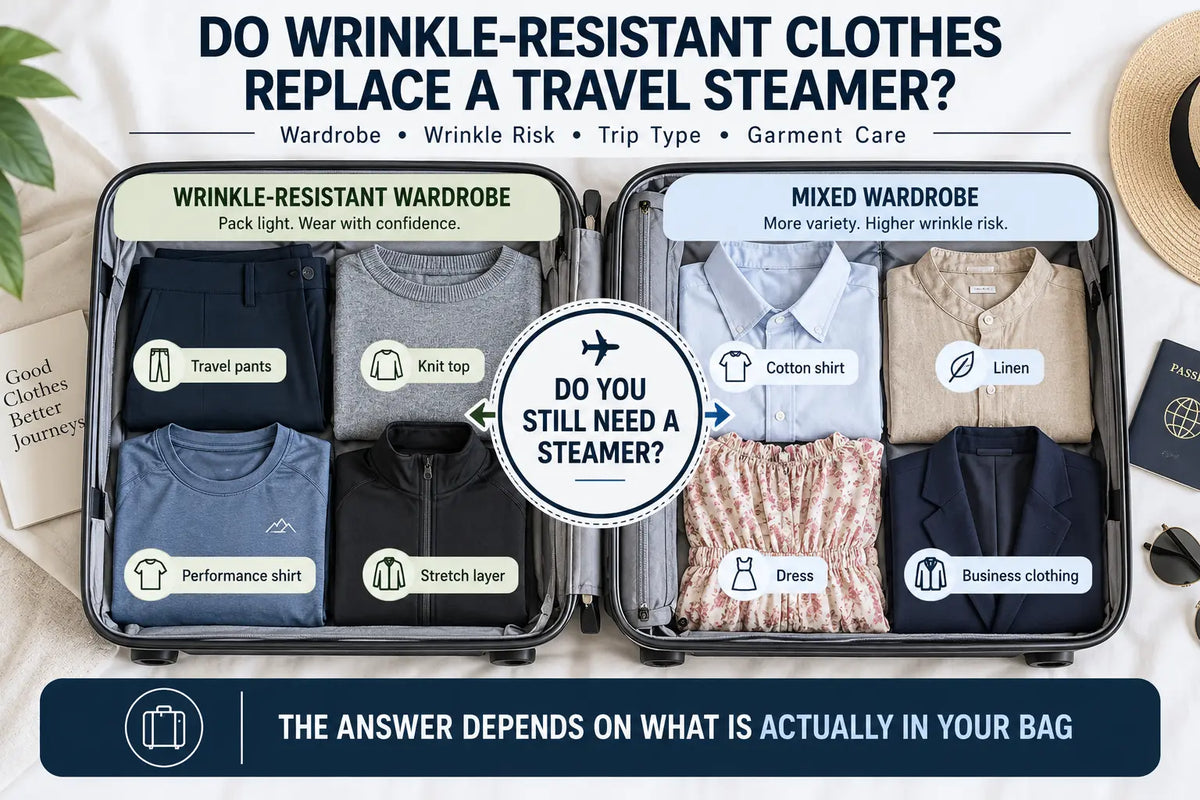
Can a Small Steamer Replace an Iron?
My answer is:
Sometimes—but not always.
If your main goal is getting rid of:
- Suitcase wrinkles
- Shirt creases
- Dress wrinkles
- T-shirt wrinkles
- Light wrinkles on jackets
then a small clothes steamer can be incredibly practical.
But if you need a sharp crease in dress pants or want to press thick fabric completely flat, an iron is still the better tool.
I think of them as two different tools for two different jobs.
An iron is more like a precision instrument.
A handheld steamer is more like a quick wrinkle-repair tool.
You wouldn’t use a ruler to fix a leaky pipe, and you probably wouldn’t grab a wrench to measure a wall.
The right tool for the job is usually the better tool.
Common Mistakes I Avoid With Portable Steamers
Holding the Steam in One Spot Too Long
More steam isn’t automatically better.
Keeping intense heat and steam concentrated in one area for too long may not be suitable for certain fabrics.
I prefer to keep the steamer moving instead of trying to attack one wrinkle with maximum heat.
Ignoring the Care Label
This is one shortcut that simply isn’t worth taking.
I’m especially careful with silk, wool, specialty blends, and garments with special coatings or finishes.
If the care label has specific instructions, those come first.
Leaving Water in the Tank
If I’m going to store the steamer for a while, I don’t leave water sitting in the tank indefinitely.
After using it, I empty any remaining water and clean the machine according to the manufacturer’s recommendations.
That can help reduce mineral buildup and unpleasant odors.
Assuming “Portable” Means “Does Everything”
The biggest advantage of a compact steamer is convenience.
That doesn’t mean it can replace every type of garment-care appliance.
When I’m choosing one, I start with the wrinkle problems I actually deal with most often and then look for the steam performance I need.
That makes much more sense to me than buying the most powerful-looking model simply because the specifications sound impressive.
My Checklist for Buying a Portable Hand Steamer
If I were starting from scratch today, I’d keep my checklist pretty simple.
First, weight.
Does it feel comfortable in my hand? That matters much more than how good it looks in a product photo.
Second, heat-up time.
If I have to wait forever, I already know I’ll gradually stop using it.
Third, steam consistency.
Steady steam is more useful than an impressive peak number.
Fourth, water tank capacity.
Choose based on how much clothing you normally steam, not simply the largest tank available.
Fifth, steam settings.
If you own a mix of fabrics, having two or more settings can be genuinely useful.
Sixth, travel compatibility.
Consider the size, voltage, plug requirements, and how easily it fits into your luggage.
Seventh, cleaning and maintenance.
Even a great steamer won’t become a long-term favorite if cleaning it feels like a chore.
Final Thoughts
I look at portable clothes steamers very differently now than I used to.
I used to ask:
“How powerful is the steam?”
Now I ask:
“When I actually need it, will I want to pick this thing up and use it?”
That sounds like a small change, but it completely changes how I shop.
For most everyday clothing, I don’t need a giant professional garment-care machine.
I need something compact enough to store easily, light enough to hold comfortably, quick enough to use when I’m in a hurry, and convenient enough to throw into a suitcase when I travel.
That’s where a portable hand steamer for clothes really earns its place.
It won’t transform my wardrobe, and it certainly won’t make laundry day exciting.
But when I’m about to walk out the door and notice a giant suitcase crease running straight across my favorite shirt, a small steamer can save me from saying:
“Whatever. I’ll just wear something else.”
And honestly, I think that’s a pretty good invention.