
Steam Iron for Everyday Clothes: I Finally Stopped Fighting Wrinkles
I used to love hanging my clothes up.
There was something satisfying about putting freshly washed clothes in the closet and seeing everything lined up neatly. It made the whole room—and honestly, my mood—feel a little more organized.
But there was one problem.
Clothes still wrinkle.
Especially the ones I wear all the time.
Shirts, dresses, lightweight jackets, soft T-shirts—you know the usual suspects. I’d pull something out of the closet in the morning and somehow find one wrinkle across the shoulder, two around the chest, and a few more on the sleeves that definitely weren’t there the night before.
None of the wrinkles were terrible.
But once the clothes were on me, they suddenly seemed much more noticeable.
I used to tell myself, “Whatever. Nobody’s going to notice.”
Then I’d catch my reflection in the elevator.
Okay.
I noticed.
Eventually, I started treating steaming as just another small part of getting dressed. Nothing dramatic. I wasn’t about to spend an hour taking care of my wardrobe. If something needed a quick touch-up, I’d just take care of it.
That’s what I like about using a steamer for everyday clothes.
It’s not necessarily about rescuing one horribly wrinkled garment.
It’s about dealing with all those little wrinkles that show up in everyday life.

Why Steam Works So Well for Everyday Clothes
Most of the clothes we wear every day aren’t seriously wrinkled.
They’ve usually just been folded, packed, or compressed somewhere.
Maybe they spent the night squeezed into a crowded closet. Maybe they came out of the dryer with a few stubborn creases. Or maybe I wore something the day before and casually tossed it over a chair because I was too lazy to hang it up properly.
We’ve all been there.
Then there’s travel.
Clothes can spend several hours folded inside a suitcase, and no matter how carefully you pack, they somehow come out looking like they’ve developed their own topography.
For wrinkles like these, steam is incredibly convenient.
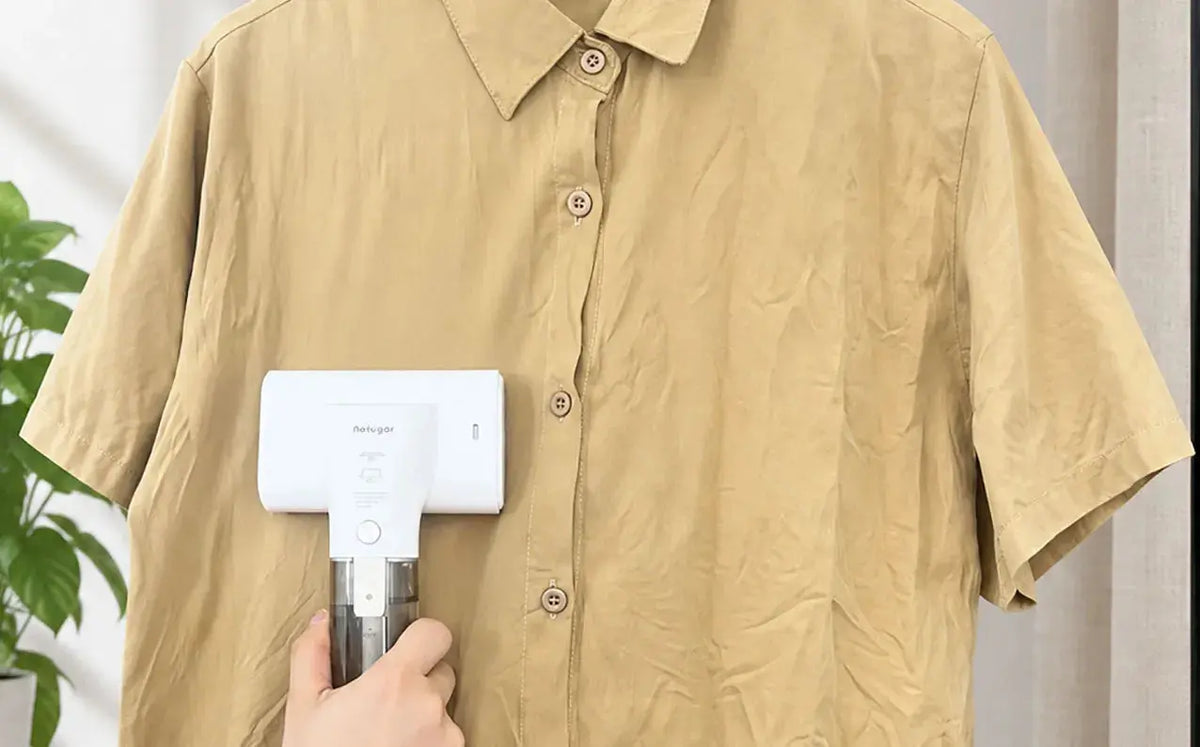
Once the garment is hanging, I let it fall naturally and then slowly move the steamer over the fabric. As the heat and moisture work through the material, the wrinkles gradually start to smooth out.
What I like most is that it doesn’t feel like I’m doing a serious household chore.
It feels more like spending a few minutes getting my clothes ready before heading out.
If I’m just trying to put on a shirt and leave the house, I really don’t want to schedule an official “clothing care session” for it.
These Are the Areas I Steam Most Often
If a garment only has a few wrinkles, I don’t steam the entire thing from top to bottom.
There’s really no need.
Take a shirt, for example.
The areas that tend to look the most noticeable are the collar, shoulders, chest, sleeves, and hem.
I start by hanging it up properly.
Then I work from the top down.
I’ll give the shoulders a quick pass, move around the collar, work down the sleeves, and then check the chest and bottom of the shirt.
Most of the time, it doesn’t take long.
And I’ve noticed something over time:
A garment doesn’t have to be perfectly smooth everywhere to look neat.
Once the most noticeable areas look natural again, the entire outfit usually looks much better.
So I’ve stopped chasing the idea of completely wrinkle-free clothes.
A little natural texture is fine.
Sometimes it actually looks better.

The Biggest Mistake With Steaming? Trying to Rush It
I’ve definitely made this mistake myself.
I see a wrinkle and immediately move the steamer closer.
Then closer again.
Thinking:
“Why is this thing still wrinkled?”
So I keep the steam focused on the exact same spot.
That’s usually not necessary.
Steaming works better as a gradual process.
Let the steam reach the fabric, move slowly, and watch how the wrinkle changes.
If the fabric is already starting to smooth out, keep moving.
For a more stubborn crease, I’d rather make another pass than hold the steam in one place for too long.
I’m especially careful with lightweight or delicate fabrics.
The garment’s care label and the steamer manufacturer’s instructions are always more reliable than my personal theory of “this should probably be fine.”
It sounds boring.
But ruin one of your favorite shirts with too much heat, and suddenly that boring advice becomes very convincing.
One Simple Trick: Give the Garment a Little Tension
This is probably one of the things I do most often now.
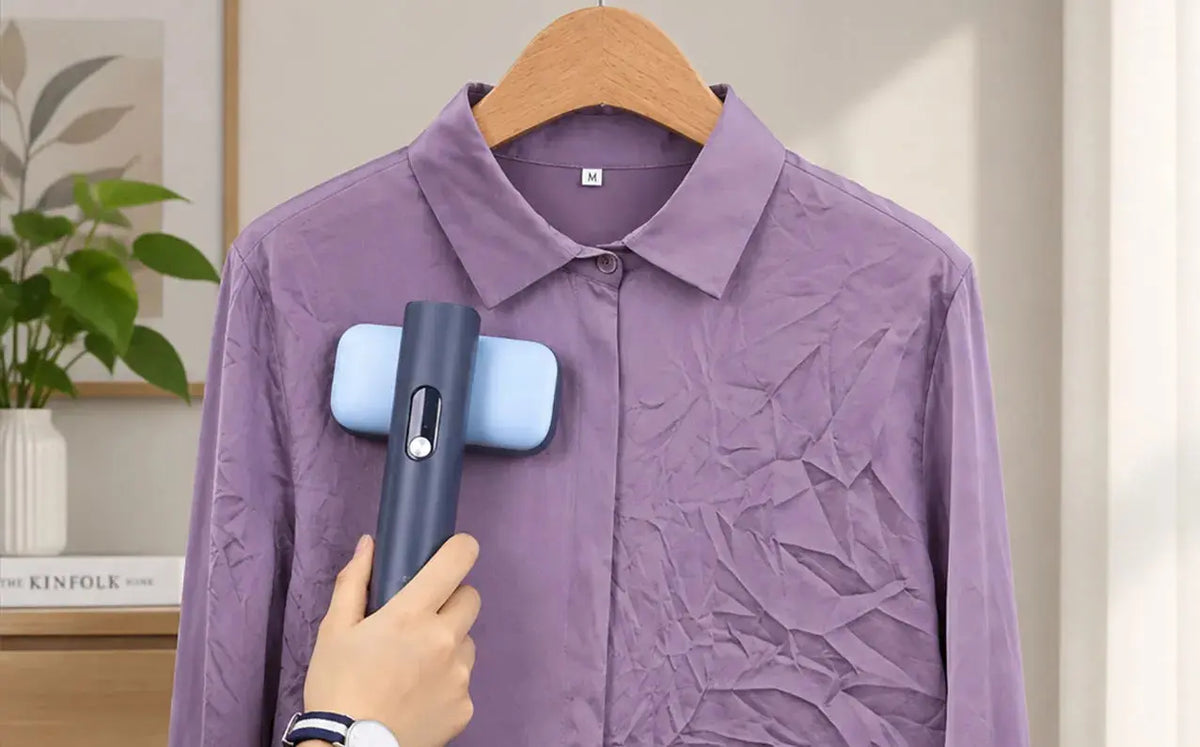
I use one hand to operate the steamer and the other to gently hold the bottom of the garment.
Not hard.
Just enough to give the fabric a little tension.
That makes it easier to move the steam evenly across the wrinkled area, and it also keeps the garment from constantly swinging around.
Sleeves are a perfect example.
If a sleeve has no tension at all, the steam moves over it, the sleeve swings back, and suddenly it feels like I’m chasing the same wrinkle around in circles.
I have better things to do.
So now I usually hold the garment lightly with one hand and move the steamer slowly with the other.
Simple, but surprisingly effective.

Different Fabrics Feel Different When You Steam Them
Everyday clothing comes in a huge range of fabrics.
So when something is wrinkled, I don’t automatically treat every garment the same way.
Cotton
Cotton shirts and T-shirts are some of the clothes I steam most often.
They can develop noticeable wrinkles, especially after washing or drying.
Steam can help those wrinkles smooth out gradually.
If the wrinkles are light, I usually don’t need to make several passes.
Linen
Linen is a little different.
It wrinkles easily.
And honestly, I’ve started to think linen looks slightly strange when it’s completely wrinkle-free.
So I’m usually not trying to make it perfectly flat.
I just want it to look clean, fresh, and intentional.
Leaving some of that natural linen texture is part of the appeal.
Polyester
Polyester and blended fabrics are extremely common in everyday clothing.
They’re often convenient to steam, but I still check the garment care label first.
Different fabrics and blends can handle different amounts of heat, so I don’t assume that one setting works for everything.
Knits
I’m gentler with knitted clothing.
I don’t pull aggressively, and I avoid keeping steam concentrated on one area for too long.
I let the garment hang naturally and slowly move the steamer across it.
Usually, that’s enough.
Delicate Fabrics
With fabrics such as silk, I slow way down.
First, I check the care label.
Then I make sure the garment is actually suitable for steaming and follow the settings recommended by the steamer manufacturer.
If I’m unsure, I’d rather test it somewhere inconspicuous first.
Because there’s a very small difference between “testing a garment” and “conducting an experiment on a garment you really like.”
What Makes a Steamer So Convenient for Everyday Clothes?
For me, the biggest advantage of everyday steaming is simple:
It has to be easy enough that I’ll actually use it.
Clothing care is incredibly easy to procrastinate.
“I’ll do it later.”
“I’ll take care of it tonight.”
“I’ll fix it tomorrow before I wear it.”
Then tomorrow morning arrives, and suddenly I have five minutes before I need to leave.
That’s when a steamer that heats up quickly and doesn’t require much setup becomes really useful.
I especially like a handheld design for this kind of routine.
Once the garment is hanging, I can steam it while standing up. I don’t need to clear a large area just to deal with a few wrinkles.
Nesugar’s clothing-care lineup also includes portable steamers designed around everyday and travel use. For people who regularly deal with small amounts of wrinkling, I think the simple “pick it up and use it” experience can matter more than having a long list of complicated features.
Because ultimately, the value of a clothing-care device isn’t about how many things it can theoretically do.
It’s whether you’ll actually reach for it.
Steaming Is Especially Handy When You Travel
This is probably the easiest situation to understand.
When we travel, clothes get folded and packed into suitcases.
You can fold everything perfectly, but after several hours of being squeezed into luggage, there are usually going to be a few wrinkles waiting for you.
Shirts and dresses are especially good examples.
If there’s a steamer available in the hotel room, I’ll usually hang the clothes up first and let them fall naturally. Then I start with the areas that look the most wrinkled.
If I’m bringing my own steamer, I pay a lot of attention to its size and weight.
Because travel gear has one very practical rule:
If it’s too annoying to carry, I’m probably not bringing it.
The best travel steamer in the world doesn’t help much if it spends its entire life sitting at home.
That’s why, for travel, I usually care more about a compact design, easy storage, and fast heat-up than a long list of features I may never use.
How Do You Know If a Steamer Is Right for Everyday Clothes?
When I’m choosing a steamer, I don’t focus on a single specification.
I think about what using it will actually feel like.
How Fast Does It Heat Up?
This matters a lot.
Everyday clothing care usually happens in small pockets of time.
Five minutes before leaving in the morning.
Three minutes while getting tomorrow’s clothes ready at night.
A few minutes after checking into a hotel.
If a device takes too long to get ready, I’m much more likely to give up.
Does It Feel Comfortable in Your Hand?
This is easy to overlook.
When steaming, you may be holding the device around shoulder height for a while.
If the weight or grip makes your wrist tired, steaming a long dress can quickly turn into an unexpected arm workout.
I’m not trying to build my biceps while getting dressed.
Is the Water Tank Convenient?
Tank capacity matters, but I’m also interested in how easy the tank is to deal with.
Is the opening large enough?
Is it easy to fill?
Is it easy to empty and clean afterward?
Those little details can have a bigger impact on everyday use than people sometimes realize.
Is It Easy to Put Away?
If I’m going to use a steamer regularly, I want to keep it somewhere convenient—near the closet, bedroom, or laundry area.
Easy to grab.
Easy to put away.
That’s how a useful little habit actually becomes a habit.
I Don’t Wait Until My Clothes Are Really Wrinkled Anymore
This is probably the biggest change I’ve noticed since I started steaming my clothes regularly.
I used to wait until something looked seriously wrinkled before doing anything about it.
Now I don’t.
If I’m getting tomorrow’s outfit ready at night and notice a few wrinkles around the shoulders or sleeves, I’ll just take care of them.
If I get home from a trip and find a few wrinkles in my clothes after unpacking, I’ll hang everything up and deal with the obvious ones.
A few minutes is usually enough.
Waiting until the wrinkles become much worse only makes the whole thing feel more annoying.
So for me, the easiest approach to everyday clothing care isn’t “steam your clothes perfectly every day.”
It’s much simpler:
See a wrinkle. Deal with it. Move on.
The smaller the problem, the easier it is to fix.
A Steamer Is Really About the Clothes You Actually Wear
If your everyday wardrobe is mostly shirts, T-shirts, dresses, lightweight jackets, and other garments that tend to pick up light wrinkles, steaming can fit naturally into your routine.
It doesn’t have to become a formal chore.
Hang the garment.
Turn on the steamer.
Focus on the obvious areas.
Let the fabric smooth out.
Put it on.
That’s it.
I’ve grown to like this approach because it doesn’t feel overly complicated.
It’s not:
“Today I am going to perform serious clothing maintenance.”
It’s more like:
“This shirt is a little wrinkled. I’ll fix it real quick.”
Then I go back to my coffee.
Then I leave the house.
Then I get on with my day.
At the end of the day, I don’t use a steamer because I need every piece of clothing in my closet to look perfectly wrinkle-free.
I just want those little everyday wrinkles to stop being one more thing I have to think about before walking out the door.
Clothes can still look lived-in.
They just don’t have to look like they’ve been in a wrestling match with your suitcase.
And honestly?
That’s good enough for me.