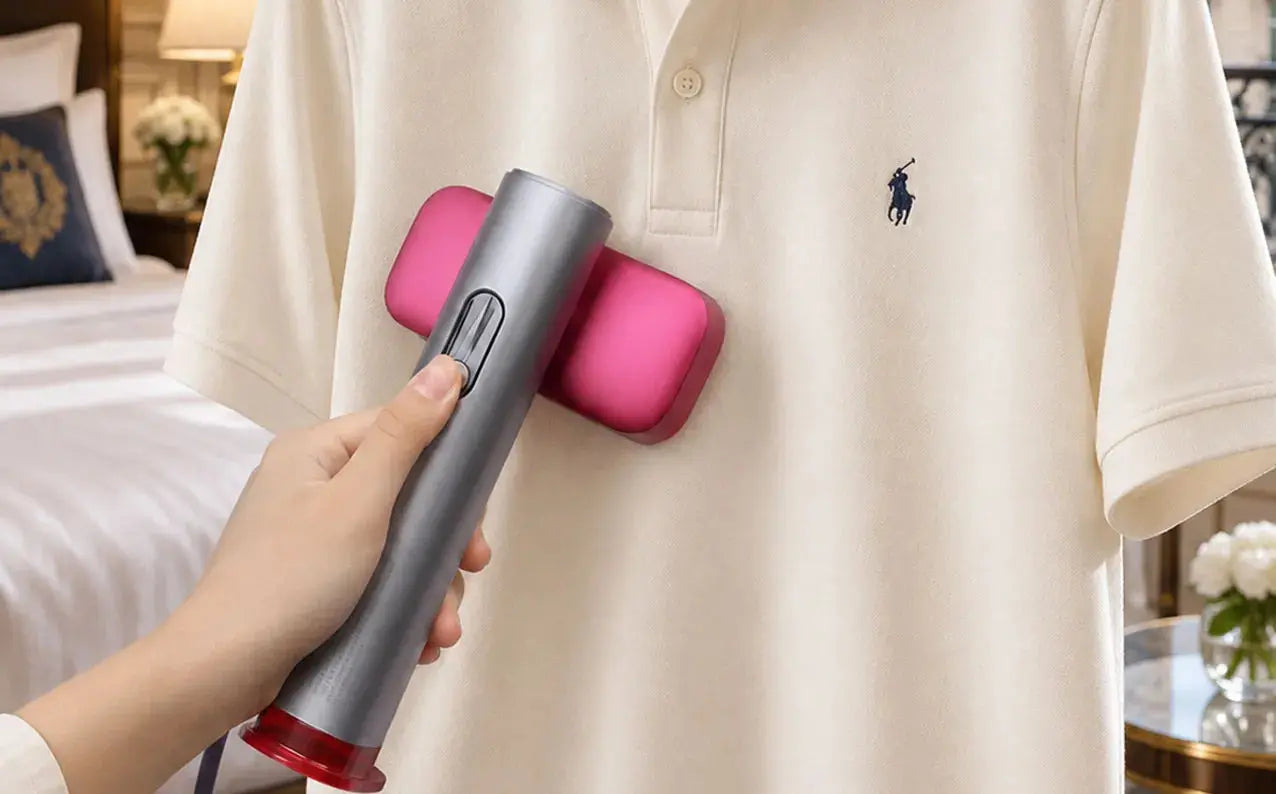

Small Travel Steamer for Clothes: The One I Never Travel Without
I used to think that every extra item I packed into my suitcase was just another way to make my life harder.
I already had enough chargers. There was never enough room for shoes. And my toiletry bag somehow looked like a miniature department store.
And bringing an iron?
Absolutely not.
My rule was simple: Hotels have irons. Why would I bring my own?
Then one time on a business trip, I opened my suitcase at the hotel and pulled out the shirt I planned to wear the next morning.
It barely looked like a shirt anymore.
The cuffs were wrinkled, the collar was crushed, and there was a weird crease running straight across the middle that I couldn't explain.
I stared at it for a few seconds before reluctantly pulling out the hotel iron.
The ironing board was ridiculously small. The cord was too short. And somehow, the whole process was more annoying than preparing for the meeting itself.
That was when I started seriously looking into a small travel steamer for clothes.
Looking back, I wouldn't say everyone needs one. But if you travel often for work, take vacations, go to weddings, or just like your clothes to look decent, a compact garment steamer can be pretty handy.

Why I Prefer a Travel Steamer
The biggest thing for me is not having to set up an entire “ironing station.”
With a traditional iron, I usually have to find an ironing board, clear some space, and wait for it to heat up. When I'm traveling, I don't need to press my suit like it just came back from a tailor.
I just want to take a wrinkled shirt out of my suitcase and make it look presentable again.
That's where a small travel steamer really shines.
I just hang the garment up, turn on the steamer, and work my way slowly from top to bottom. For the kinds of clothes I usually pack—shirts, dresses, linen pieces, lightweight jackets—it can usually handle a quick refresh in just a few minutes.
What I especially like is that I don't need to find a table or turn my hotel room into a temporary laundry room.
Travel is already enough of a hassle. I don't need to wrestle with an ironing board, too.
What I Actually Look for in a Travel Steamer
I used to get distracted by long lists of specifications whenever I bought a small appliance.
900 watts. 1,200 watts. Steam output. Heat-up time.
It all sounded very impressive.
But after taking a few of these steamers on trips, I realized that the things I actually care about are pretty simple.
1. Weight Matters More Than I Thought
There's a cruel rule with travel gear: everything feels light when you're holding it on its own, but somehow your suitcase gets heavier with every little thing you add.
So I tend to prioritize compact, lightweight handheld designs.
For example, the Nesugar G2 Pro and G3 Pro are both around 0.8 lb. That's light enough that I'd have no problem throwing one into my carry-on or backpack.
For me, lightweight isn't about looking sleek.
It's about actually being willing to pack the thing.
2. Heat-Up Time Matters More Than You'd Think
If a travel steamer takes forever to heat up, there's a good chance it will spend most of its life sitting in my suitcase.
Nesugar lists an approximately 15-second heat-up time for the G2 Pro, G3 Pro, and G5 Pro.
That matters when I'm actually traveling.
If I'm rushing to a morning meeting or suddenly discover that my shirt looks like it spent the night fighting with my suitcase, I want something that starts steaming quickly after I plug it in.
3. Check the Voltage Before International Trips
This is one detail I wouldn't skip.
If you're traveling within the U.S., voltage is relatively straightforward. But if you're heading to Europe, Japan, or other countries, 100–240V global voltage compatibility is worth paying attention to.
For example, the G2 Pro and G5 Pro are listed as supporting 100–240V. Keep in mind, though, that plug shapes can still vary by destination. Voltage compatibility does not necessarily mean you can plug the device directly into every wall outlet around the world.
I've developed a simple rule when buying travel electronics:
Check the voltage before you check how pretty it looks.
Because finding out you can't even use it after you arrive at your hotel is a pretty frustrating surprise.

What Clothes Work Best With a Steamer?
In my experience, steamers work best on lightweight fabrics and clothes that wrinkle easily.
Linen shirts are at the top of my list.
I love linen, but it has a strange superpower: you can smooth it out perfectly, and somehow it manages to develop a completely new set of wrinkles ten minutes later.
The steam helps relax the fibers and makes the fabric look smoother without flattening it completely.
Cotton shirts are also easy to handle.
I usually focus on areas where wrinkles are most noticeable, such as the collar, cuffs, chest, and hem.
I also like steaming suits and lightweight jackets while they're hanging.
I don't try to make everything look absolutely perfect.
When I'm traveling, I care more about making the whole outfit look clean and polished.
As for delicate fabrics such as silk and wool, I always check the care label first and use a gentler steaming technique. Just because a steamer says it's safe for multiple fabrics doesn't mean I treat every garment the same way.
Clothes generally don't appreciate that kind of confidence.
My Simple Hotel-Room Steaming Routine
My hotel-room routine is pretty simple.
On the first night at the hotel, I hang up whatever I'm planning to wear the next day.
If something is obviously wrinkled, I deal with it ahead of time instead of discovering the problem five minutes before I have to leave in the morning.
When I steam something, I let it hang naturally and slowly move the steamer from top to bottom. If there's a particularly stubborn wrinkle, I'll spend a few extra seconds on it rather than repeatedly going over the entire garment.
Once I'm done, I don't put the clothes on immediately.
I usually let them hang for a little while so any remaining moisture can evaporate. I'll also take a quick look to make sure there aren't any obvious wrinkles left.
That little habit has saved me from putting on a shirt that looks smooth but still feels slightly damp.

A Small Travel Steamer Isn't a Miracle Worker
If you're trying to smooth out heavy fabrics or create those razor-sharp trouser creases and crisp shirt folds you get from a traditional iron, a regular iron still has the advantage.
A travel steamer is better suited for:
- Removing suitcase wrinkles quickly
- Touching up clothes in a hotel room
- Getting ready for a business trip
- Packing for a weekend getaway
- Getting an outfit ready for a wedding or formal event
- Refreshing clothes with light to moderate wrinkles
So I wouldn't think of it as a complete replacement for a traditional iron.
To me, it's more like a travel emergency kit for your clothes.
It's not something I think about every day, but when I need it, I'm always glad I packed it.
Is It Worth the Extra Space in My Suitcase?
The funny thing about travel is that I always seem to want to bring more stuff while somehow making my suitcase lighter.
My thinking has changed.
I no longer ask, “Is this absolutely essential?”
I ask, “Will this save me ten or fifteen minutes of frustration when I actually need it?”
If a small travel steamer lets me fix a wrinkled shirt in my hotel room without hunting down an ironing board or figuring out how to use the hotel's iron, I'm happy to give it a little space in my suitcase.
And with newer travel steamers getting lighter, heating up faster, and offering features like multiple steam settings and worldwide voltage compatibility, I find them easier to justify packing.
I wouldn't say a travel steamer will change your trip.
But it might change one very specific morning.
You open your suitcase.
You see the wrinkled shirt.
You don't sigh.
You don't call the front desk for an ironing board.
You plug in the steamer, wait a few seconds, and spend a few minutes getting the shirt back into shape.
Then you go get your coffee.
For me, that's more than enough.