
Travel Steamer for Europe: How to Choose One That’s Actually Worth Packing
One of the little annoyances of traveling in Europe is opening your suitcase and finding everything wrinkled.
Your shirt comes out looking like it lost a fight. Your linen pants are covered in creases, and your blazer looks like it spent the whole trip at the bottom of your suitcase.
If your hotel room has an iron, great. If it doesn’t, you’re left standing in front of the mirror wondering how you’re supposed to make that outfit presentable.
That’s why I started paying more attention to travel steamers.
After trying a few on actual trips, I’ve realized that choosing a travel steamer for Europe is simpler than it sounds. But there’s one thing that should come before everything else:
Voltage.

Why Voltage Matters More Than “Powerful Steam” in Europe
The U.S. typically uses 120V, while most of Europe uses 230V. That means a travel steamer designed only for U.S. voltage does not magically become compatible with European outlets just because you brought a plug adapter.
A plug adapter only changes the shape of the plug. It does not convert voltage.
This is one of the easiest mistakes to make when buying a travel steamer.
If you’re traveling internationally, look for a model that clearly supports multiple voltages, such as 100–240V, or otherwise covers both 110–120V and 220–240V. Voltage compatibility should be one of the first things you check before buying a travel steamer.
If your itinerary includes Paris, Rome, and Amsterdam, with a side trip to London, it gets even more important to think about both voltage and plug types. The U.K. uses a different plug type from most of continental Europe.
My rule is simple: check the voltage first, the plug second, and the looks last.
After all, a beautiful steamer that you can’t safely plug in isn’t doing much for your wrinkled shirt.
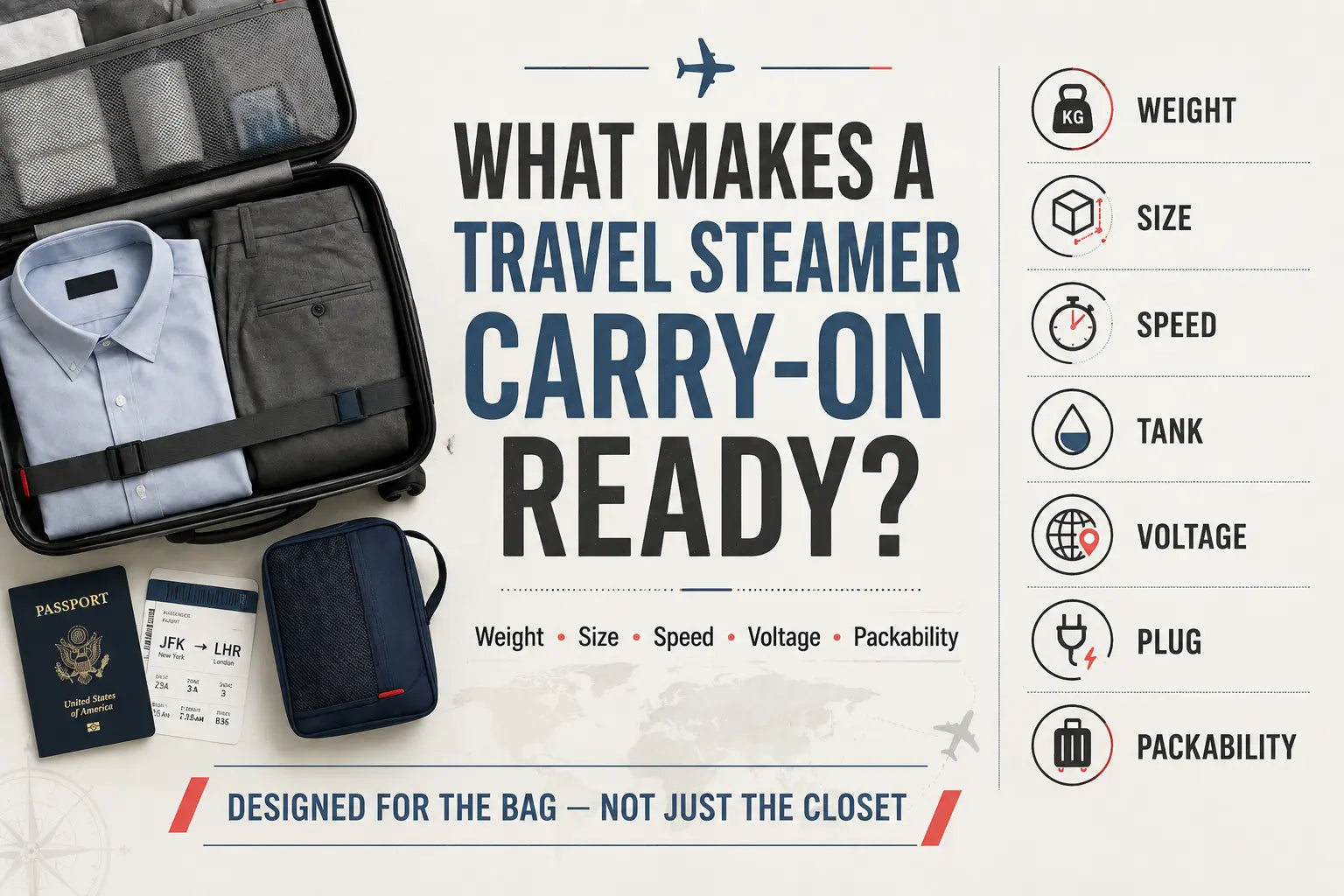
The 5 Things I Look for in a Travel Steamer
1. Dual Voltage or 100–240V Compatibility
This is the first filter.
If you’re considering a Nesugar Pro Series model, check the voltage rating for the specific model before buying. The lineup includes models with different voltage specifications, so it’s important not to assume that every “travel” model is compatible with every destination.
Still, I wouldn’t rely on the word “travel” alone.
Always check the voltage rating for the exact model you’re buying, along with the product specifications or manual, before you leave home.
Electrical specifications can vary between models and markets. “Travel steamer” does not automatically mean “works everywhere in the world.”
2. Weight and Size
The biggest enemy of a travel steamer isn't wrinkles. It's your baggage allowance.
If I’m flying a European budget airline, I’d rather leave a couple of “just in case” outfits at home than give up valuable carry-on space to a full-size iron.
A good travel steamer should fit comfortably into a carry-on without making you feel like you packed a full-size iron.
For frequent travelers, compact design and reasonable weight can matter just as much as steam performance.
3. Heat-Up Time
When I’m traveling, I rarely have time to prep my clothes half an hour in advance.
It’s usually more like:
“I have ten minutes before I need to leave.”
“Where’s my shirt?”
“...Oh no.”
That’s why fast heat-up matters.
Whether you’re rushing to catch a train, heading to a business meeting, or trying to make it to the airport on time, a steamer that heats up in seconds can make a big difference when you’re in a hurry.
4. Is the Water Tank Big Enough?
Compact travel steamers aren't going to have huge water tanks. That’s part of the trade-off for keeping them small and portable.
For me, the important things are simpler:
Is the tank easy to fill? Does it leak? And is it easy to empty when I’m done?
I also make a point of emptying the water tank at the end of a trip. It’s a small habit, but there’s little reason to leave water sitting inside your steamer while it’s packed away.
5. Does It Work for the Clothes You Actually Pack?
A travel steamer isn’t a magic wand.
For shirts, dresses, blazers, lightweight knits, and other wrinkle-prone clothes, a steamer is usually much more convenient. After several hours stuffed into a suitcase, hanging the garment up and steaming it is usually much easier than trying to smooth out the wrinkles by hand.
But if you’re dealing with heavyweight denim or want a crisp crease in your pants, a traditional iron still has the advantage.
My rule of thumb is simple:
Use a steamer to quickly refresh your clothes. Use an iron when you want crisp, sharp creases.

How to Use a Travel Steamer in Europe Without Making Things Worse
I usually hang the garment up rather than laying it flat.
Let the fabric hang naturally, then slowly work your way up from the bottom. Collars, cuffs, and heavily folded areas may need a little extra attention.
Also, don’t assume every fabric should be treated the same way. Avoid holding the steamer too close to delicate fabrics, and always check the garment’s care label before steaming.
And here’s one small trick that makes a difference:
Don’t immediately throw the garment back into your suitcase after steaming it.
Give it a few minutes to cool before folding it.
Otherwise, you’ve just spent several minutes getting rid of the wrinkles only to fold the shirt right back up again.
That’s basically the travel version of undoing your own work.
What I’d Pack for a Simple Clothing-Care Kit
If I could only bring the basics, I’d pack:
- A travel steamer that supports the voltage used at my destination
- The appropriate plug adapter
- Two or three lightweight clothes hangers
- A small waterproof pouch
The plug adapter is probably the easiest item to overlook.
Dual voltage doesn't mean the plug will fit every outlet.
A steamer can be compatible with the local voltage and still have a U.S.-style plug that won’t fit directly into outlets in France, Italy, or the U.K.
And when flying, I’d empty the water tank before packing the steamer. Check your airline's and airport's current rules for travel appliances and liquids before you fly.

The Best Travel Steamer Isn’t the “Most Powerful” One. It’s the One That Causes the Least Trouble.
I’ve started using a pretty simple rule when choosing travel gear:
It should solve a problem, not create a new one.
A good travel steamer for Europe doesn't need the highest steam output, the most features, or the fanciest design.
For me, it should be lightweight, voltage-compatible, quick to heat up, easy to fill and empty, and capable of handling the clothes I actually pack.
Nesugar’s Pro Series currently includes several portable models, including the G2 Pro, G5 Pro, G6 Pro, G9 Pro, and G10 Pro, with different features and specifications depending on the model.
Before buying one, I'd start with three questions:
Which countries are you visiting? What voltage and plug types do they use? And what kind of clothes are you packing?
Those answers will usually narrow down your options pretty quickly.
Because European travel already comes with enough logistics.
You really don’t need to spend every morning having a personal argument with a wrinkled shirt.