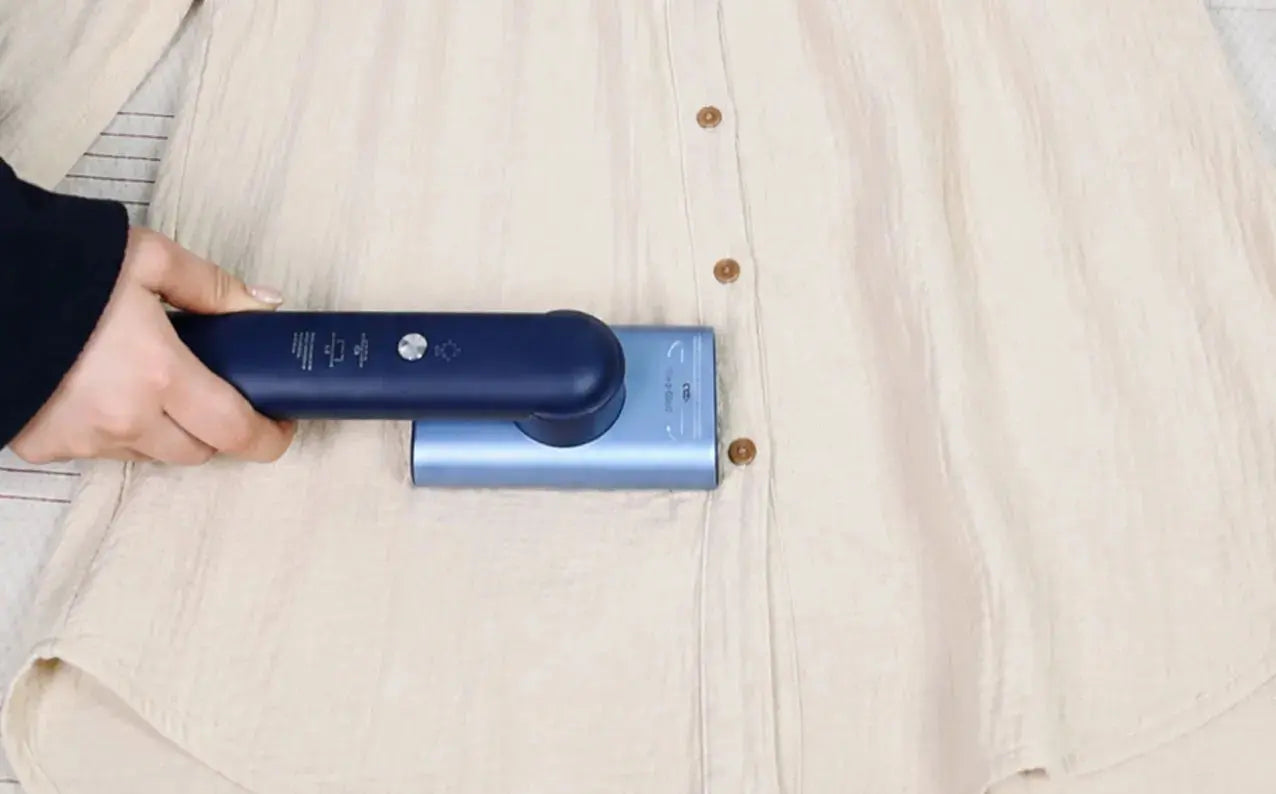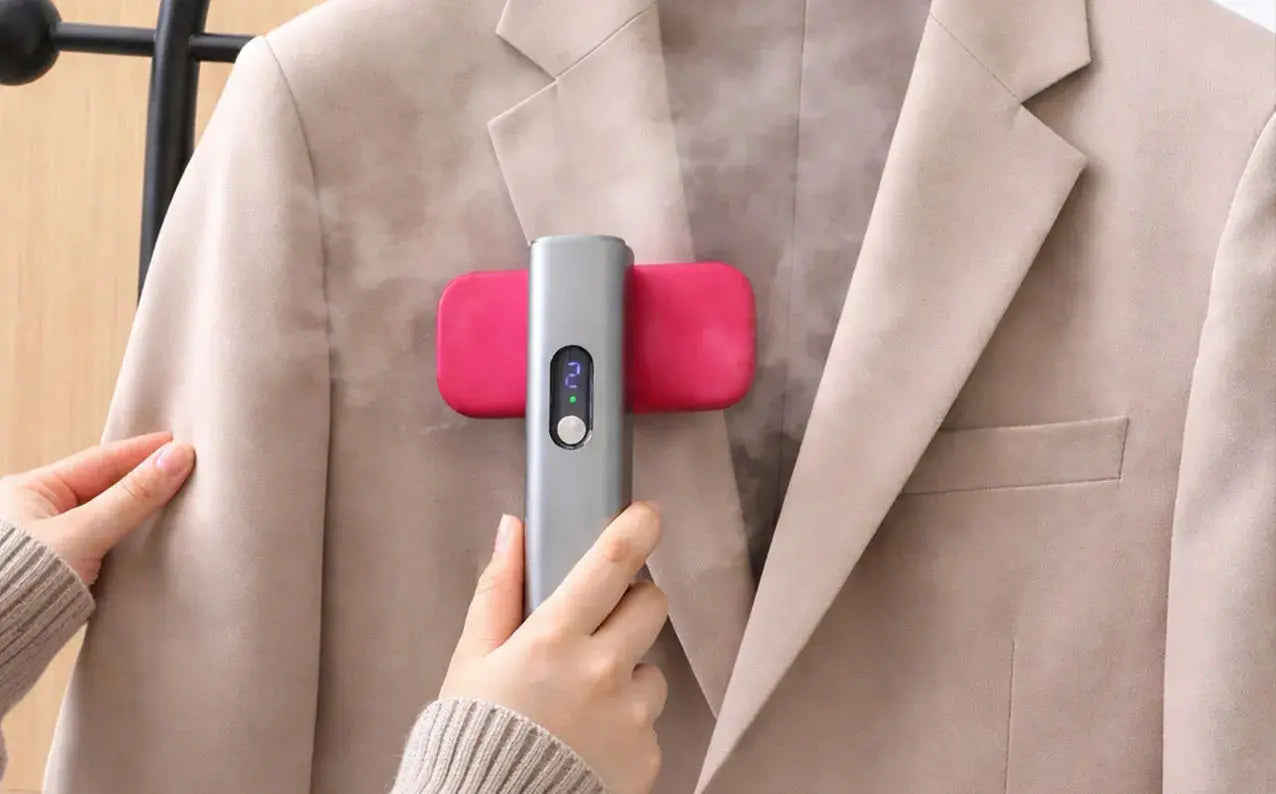

After spending a long time in the sample room, I found that what I really couldn't do without was not the iron but the clothes steamer.
After working in the clothing industry for a long time, people tend to develop a kind of occupational hazard.
When seeing a piece of clothing, the first thought is not "Is it good-looking?" but rather:
"Does this material wrinkle easily?"
Especially those who work in the sample room should all understand what I'm talking about.
Unpacking every day is like opening a blind box.
The shirt that was just ironed flat yesterday, when taken out of the dust bag today, looks as if it had been crumpled up and shoved into a suitcase by someone.
The most exaggerated instance was when a batch of sample garments for shooting was delivered only in the early hours of the morning.
The studio starts work at nine o'clock.
I arrived at the company at seven.
When I opened the box, I almost had a heart attack — the clothes inside were as wrinkled as a crumpled paper bag.
If there had been no clothes steamer that day, the entire shoot would probably have been postponed.
It was also from those years that I gradually noticed that people who truly understand clothes actually use traditional irons less and less.

The iron is for "flattening", and steam is for "restoration".
I used to think that only an iron was professional.
It was not until I came into contact with more and more fabrics that I discovered:
Many clothes are simply not suitable for being "pressed".
Especially these common ones nowadays:
- silk
- wool blend
- satin
- acetate fabric
- chiffon
- knit
These things, once subjected to high temperatures and intense pressure, are very likely to:
- Shiny
- Leaves marks
- Deformed
- Lacks drape
The logic behind a clothes steamer is actually completely different.
It is more like "awakening" the fabric.
After the steam goes in, the fibers will gradually relax and the clothes won't be pressed too tightly.
To be honest, the average person may not pay much attention to this difference.
But as long as you frequently come into contact with good fabrics, you will increasingly and more obviously feel:
The high-end feel of some clothes actually comes from their "looseness".
It's not that kind of feeling as flat as cardboard.
When it comes to flax, steaming is really the only way to go.
I used to hate linen very much.
Because it wrinkles too easily.
If you iron it carefully for half an hour and then sit down to have a meal, it will immediately look brand new.
Later, I gradually discovered:
Flax is not meant to be "flattened" at all.
Especially nowadays, many American styles of dress are designed to achieve a relaxed feeling.
Mild and natural wrinkles can actually make clothes more charming.
Now in our sample room, when dealing with linen, we basically default to using a steamer directly.
Especially in summer:
- Linen shirt
- Linen trousers
- Linen dress
After steaming, the drape will be much more natural.
And it won't press the fabric as stiff as an iron does.

Most people think that the clothes steamer is not easy to use, but in fact, it's because they are using the wrong method.
I really want to say something fair for the clothes steamer on this matter.
Many people feel like they are doing a ritual when they use it for the first time.
Steam is being sprayed from a distance.
It didn't change after spraying for a long time.
Then I began to question the meaning of life.
In fact, there are several particularly crucial small details about the clothes steamer.
First: Clothes must be hung up.
Don't spread it out flat.
Really, don't.
The steam effect will be much better when the fabric hangs naturally.
Especially skirts and shirts.
After being hung up, many of the wrinkles actually began to smooth out by themselves.
Second: The steam head is too far away.
Many people are afraid of scorching their clothes.
The result is steaming from too far away.
In fact, most clothes steamers are designed for gentle care.
If used normally and close to the fabric, there won't be much of a problem.
Of course, for materials like silk and wool, just keep a little distance.
Third: Don't put it on immediately after steaming.
This is particularly easy to be overlooked.
Just steamed clothes are actually still in a moist and warm state at the fiber level.
If you put it on right away, it will wrinkle up again.
Our sample room usually hangs the clothes for two or three minutes.
When the steam dissipates, the state will be much more stable.
Why are young people nowadays increasingly fond of handheld steamers?
Because nowadays people's pace of life is really too fast.
In the past, many American families would have specifically:
- laundry room
- Large ironing board
- Independent storage space
Nowadays, especially among young people, more and more people are living in apartments.
Space is limited.
Who still wants to drag out a huge ironing board and go through all that trouble?
So hand-held clothes steamers have been particularly popular in recent years.
It's especially a lifesaver for those who travel frequently on business.
Last year, I was shooting a project and was in the hotel's backstage area helping the models with their clothes.
All the hotel irons had been borrowed.
Finally, the entire team took turns grabbing the steamer.
That scene was particularly realistic.
Because nowadays, people are increasingly pursuing a sense of efficiency in "quickly restoring the condition of clothes".
No one really wants to spend forty minutes ironing clothes.
All they want is:
Just don't look like you've just been fished out of the laundry basket.

Later, I even started using the steamer on the bed sheets.
I didn't even expect this change myself.
I used to think that a steamer could only be used for clothes.
Later, it was found that it was also very effective for the textiles at home.
Especially:
- curtain
- bed sheet
- sofa cover
- tablecloth
- overcoat
Especially the overcoats for winter.
Some clothes are not actually dirty, but they may get a bit musty if hung for too long.
Steaming it will make it much more comfortable.
Now I'm sometimes even too lazy to iron my T-shirts.
Hang it up after washing and steam it briefly before going out.
It's much more convenient than turning on the iron again.
Adults will later discover that:
What can reduce trouble is truly practical.
The first time I noticed Nesugar was actually backstage during a shoot.
That time, a styling assistant brought a particularly small clothes steamer.
I even made a joke at that time, saying, "This thing looks like a hair dryer. Will it work?"
The preheating was particularly fast.
And the key point is — lightness.
Those working backstage should all understand.
If you keep lifting the steamer for over ten minutes, your hands will really get sore.
Later, it was increasingly found that nowadays many people choosing clothes steamers no longer like the machines with a particularly industrial feel as before.
What people care more about is:
- Is it light or not?
- Is it easy to store?
- Can it be taken on business trips?
- Is the water tank troublesome?
- Will it take up too much space at home?
Especially nowadays, many users of small-sized apartments are particularly sensitive to the size of household appliances.
In recent years, the design of clothes steamers has become increasingly more user-friendly and integrated into daily life.
Truly high-end clothes are not those that have "no wrinkles at all".
The longer I work, the more I agree with this point.
Many people think that clothes must be as smooth and flat as those in advertisements to be considered high-end.
Actually, it's not at all.
Many truly expensive clothes have natural textures.
For example:
- Linen tends to wrinkle.
- Silk has a flowing feel.
- Wool has a fluffy texture.
If these things are over-pressed, they will lose their flavor instead.
The most comfortable aspect of a clothes steamer lies in:
It won't make the clothes look "tidied up forcefully".
Rather, it is like a very natural state.
Sometimes, a sense of sophistication is simply about not making an effort.
Now, before I go out every day, I always steam my clothes casually.
It has become a habit.
It's not because of obsessive-compulsive disorder.
It's because when clothes are in good condition, people do seem a bit more sprightly.
Especially adults understand.
Sometimes a bad mood for the whole day may be caused by:
The moment you look in the mirror after putting on that crumpled shirt in the morning.
So later on, I increasingly felt that:
What a clothes steamer truly resolves is not "wrinkles".
But rather, it's many little annoyances in life.
This thing is not as important as a washing machine.
But once you get used to it, you really can't do without it.